

Bangladesh Breaks the South Asian Paradox on Overseas Voting
Bangladesh breaks a South Asian deadlock by implementing overseas voting. Postal, digital, and embassy systems end decades of exclusion and give the diaspora a direct voice in national democracy.

জাতীয় নির্বাচনে প্রবাসী নাগরিকদের ভোটাধিকার কার্যকর করে বাংলাদেশ দক্ষিণ এশিয়ায় ‘গণতন্ত্র ও নাগরিক অধিকার প্রতিষ্ঠায় এক গুরুত্বপূর্ণ দৃষ্টান্ত স্থাপন করেছে। সার্কভুক্ত দেশগুলোতে প্রবাসীদের ভোটদানের আইনি কাঠামো থাকলেও কেউ তা বাস্তবায়ন করতে পারেনি। জুলাই ২০২৪-এ শিক্ষার্থী-জনতার বিপ্লব পর্বর্তী বাংলাদেশ ২.০ যাত্রায় প্রবাসীদের ভোটাধিকার হয়ে উঠেছে গণতান্ত্রিক অন্তর্ভুক্তির এক ঐতিহাসিক মাইলফলক।
Democratic citizenship is no longer confined within national borders. In the 21st century, large-scale migration and the growing political influence of diasporas have reshaped how democracy works. Against this backdrop, Bangladesh’s recent move to institutionalize overseas voting marks a significant moment, not just for the country, but for South Asia as a whole. This article situates Bangladeshi decision within a broader regional and global context, especially highlighting how the country has moved faster, and more decisively, than its South Asian neighbors.
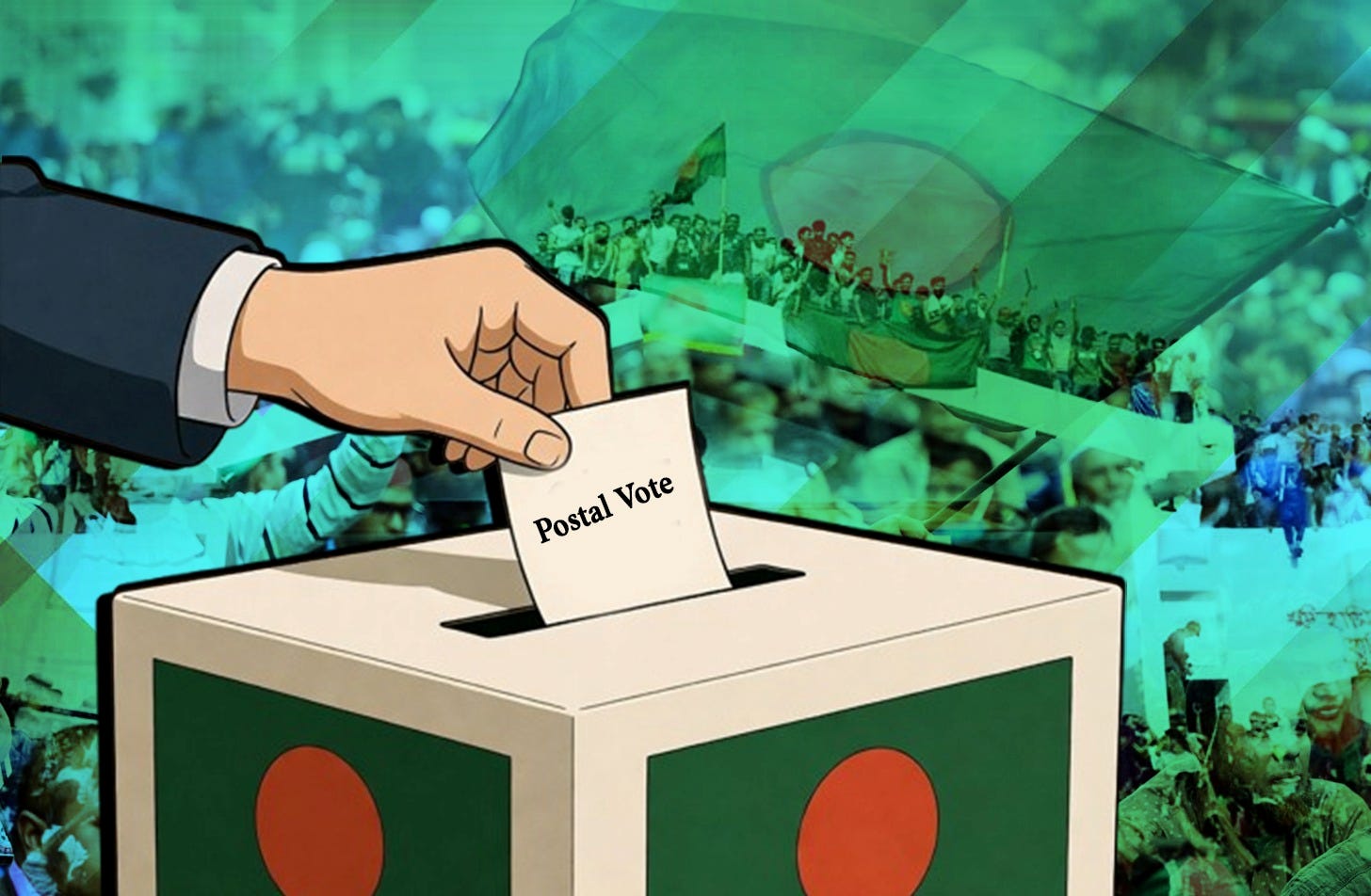
The 2024 student-led mass uprising and the subsequent fall of the Sheikh Hasina regime created a moment of democratic reckoning. In the aftermath, Bangladesh began reassessing who counts as a political citizen. More than 140 countries around the world already allow citizens living abroad to vote in national elections. South Asia, however, has long remained an exception. Following the July 2024 student-mass uprising, Bangladesh’s decision to enfranchise expatriate voters marks a clear break from that pattern. The move highlights how democratic reform can shape regional geopolitics, giving Bangladesh new soft power and a lead role advancing transnational democracy across South Asia.
Bangladeshi diaspora, estimated at over 9 million migrant workers and 3.4 million permanent immigrants, sends billions of dollars home each year. These remittances make expatriates a powerful economic force. Yet for decades, this same group remained politically invisible, unable to vote or influence the country’s political direction. This gap between economic contribution and political exclusion reflects what Allen and his colleagues have described as South Asia’s paradox of delayed enfranchisement: legal provisions exist, but implementation is stalled by institutional inertia, administrative weakness, and logistical complexity.
Diaspora, Democracy, and Citizenship Beyond Borders
Today, diasporas are no longer distant observers of homeland politics. They function as transnational constituencies, shaping national debates from afar. Across the world, overseas voting has emerged both as a democratic right and as a form of soft power, allowing states to maintain symbolic and political ties with their citizens abroad.
In South Asia, however, these developments have been constrained by colonial legacies in public administration and postcolonial anxieties around sovereignty, loyalty, and national identity. Bangladesh stands out because of its high levels of outward migration, deep reliance on remittances, and long, if turbulent, electoral history. Yet migrant workers, often labeled “temporary” or “low-skilled,” were systematically excluded from the political process due to bureaucratic hurdles, weak postal systems, and limited embassy capacity.
The Representation of the People (Amendment) Act of 2013 technically granted expatriates the right to vote through postal ballots. In practice, the system was unworkable. Voters had to apply to district offices in Bangladesh, wait for ballots to arrive by post, and return them within narrow timeframes. As the 2018 election demonstrated, these constraints made voting from abroad nearly impossible. That is, overseas citizens had a legal right to vote, but no realistic way to exercise it.
That changed after 2024. As authoritarian rule gave way to democratic reform efforts, an interim electoral reform committee reviewed global models and introduced a hybrid system combining postal voting, electronic registration, and in-person voting at embassies. In doing so, Bangladesh moved beyond symbolic recognition of citizenship toward a more inclusive and practical democratic framework.
South Asia’s Deferred Enfranchisement in Context
Bangladesh’s progress becomes clearer when compared with its regional peers. Across South Asia, according to Allen and his colleagues: overseas voting has been characterized by delayed laws, stalled implementation, and reliance on court rulings rather than legislative action. Despite large and influential diasporas, only the Maldives and Bhutan have established limited forms of regular overseas voting.
Elsewhere, reform has stalled. Sri Lanka, for instance, announced plans to allow migrant voting after political upheaval, but fiscal pressures and partisan resistance have slowed progress. Pakistan and Nepal face similar constraints. In contrast, Bangladesh has demonstrated both political commitment and administrative momentum.
The Bangladesh Election Commission (BEC) has begun piloting embassy-based voting and exploring digital identification through national ID numbers. Unlike regional counterparts, where overseas voting often remains rhetorical, Bangladesh has proactively moved into the realm of implementation.
Remittances, Power, and Democratic Accountability
The Bangladeshi diaspora was celebrated as “development heroes” but was denied their political participation. Enfranchising expatriates addresses the long-standing gap between their economic contribution and political exclusion. For years, diaspora influence functioned indirectly, through remittances, or what many describe as “voting with their wallets.”
Formal voting rights transform that imbalance into a reciprocal social contract, allowing overseas citizens to hold leaders accountable for decisions affecting migration policy, currency stability, and labor welfare. Seen this way, the July 2024 uprising was not only a political rupture, but a democratic reset that reopened questions of who truly belongs in the polity.
Granting voting rights to expatriates is therefore both practical and symbolic. It marks a departure from exclusionary governance and positions Bangladesh as a more inclusive democracy within the Global South.
Regional Impact and Democratic Leadership
According to the practice of international relations, a state when initiates a new norm within its borders can set a precedent for other states to emulate, follow, and/or adopt that norm. With the introduction of diaspora voting in Bangladesh, the country has also established itself as a norm entrepreneur and, in turn, has influenced policy discussions in other states. Policy discussions in Sri Lanka, Pakistan, and Nepal have increasingly referenced Bangladesh’s model, suggesting a spillover effect. If sustained, this shift could encourage broader democratic reform across a region long resistant to transnational enfranchisement.
At the same time, Bangladesh’s approach strengthens its moral standing in global forums. Amid rising geopolitical competition between India and China, Bangladesh’s emphasis on inclusive citizenship enhances its soft power, contrasting with India’s caution on diaspora rights and China’s restrictive policies toward overseas citizens.
At the same time, Bangladesh’s approach strengthens its moral standing in global forums. Amid rising geopolitical competition between India and China, Bangladesh’s emphasis on inclusive citizenship enhances its soft power, contrasting with India’s caution on diaspora rights and China’s restrictive policies toward overseas citizens.
Postal Voting and Democratic Deepening
Postal voting has generated significant enthusiasm among Bangladeshis abroad. More than 1.5 million eligible voters, including expatriates, government officials on duty, and other groups, can now participate in national elections. Citizens across 123 countries are able to vote, reinforcing the link between the state and its global population.
The introduction of the ‘Postal Vote BD’ app signals a broader commitment to technological modernization. While challenges remain, postal voting has the potential to influence closely contested constituencies and strengthen the representative legitimacy of elections.
Ultimately, Bangladesh’s embrace of overseas voting represents a decisive break from South Asia’s tradition of diaspora exclusion. It allows citizens to participate politically without returning home and reaffirms democracy as a living, adaptive system rather than a fixed institutional ritual.
About the Author
Shah Jahan Shuvo is the Social Media Editor, The Insighta. He is a researcher and journalist. He can be reached at jahanbdasia@gmail.com
Disclaimer: The views expressed in this article are the authors' own and do not necessarily reflect The Insighta's editorial stance. However, any errors in the stated facts or figures may be corrected if supported by verifiable evidence. | A guest post by
|