

How Postal Votes Could Reshape Bangladesh’s 13th National Election
Bangladesh’s 13th election may hinge on postal votes as 1.5 million people register to vote by mail. In close races, these ballots from home and abroad could swing results.

বাংলাদেশের নির্বাচনী ইতিহাসে প্রথমবার পোস্টাল ভোট বা ডাকযোগে ভোট বড় ভূমিকা রাখতে যাচ্ছে। ১৫ লাখের বেশি নিবন্ধিত ভোটার, হাড্ডাহাড্ডি লড়াই আর প্রবাসী ভোটে বদলে যেতে পারে বহু আসনের ফল। ১২ ফেব্রুয়ারী অনুষ্ঠেয় ত্রয়োদশ জাতীয় সংসদ নির্বাচনে কিছু কিছু আসনে জয়-পরাজয়ের অন্যতম নিয়ামক হবে পোস্টাল ভোট।
For the first time in Bangladesh’s electoral history, postal votes may play a decisive role in a national election. More than 1.5 million voters have registered under a new postal voting system. This means the 13th National Parliamentary Election may depend not only on votes cast at polling stations, but also on ballots mailed from inside Bangladesh and from abroad.
The Election Commission (EC), led by A M M Nasir Uddin, introduced the system to meet long-standing demands from expatriate Bangladeshis and officials unable to vote on election day. What makes this change significant is not just that it is new, but that it involves a very large number of voters. In several constituencies, postal voter registration has crossed 10,000, higher than the winning margins in many past elections.
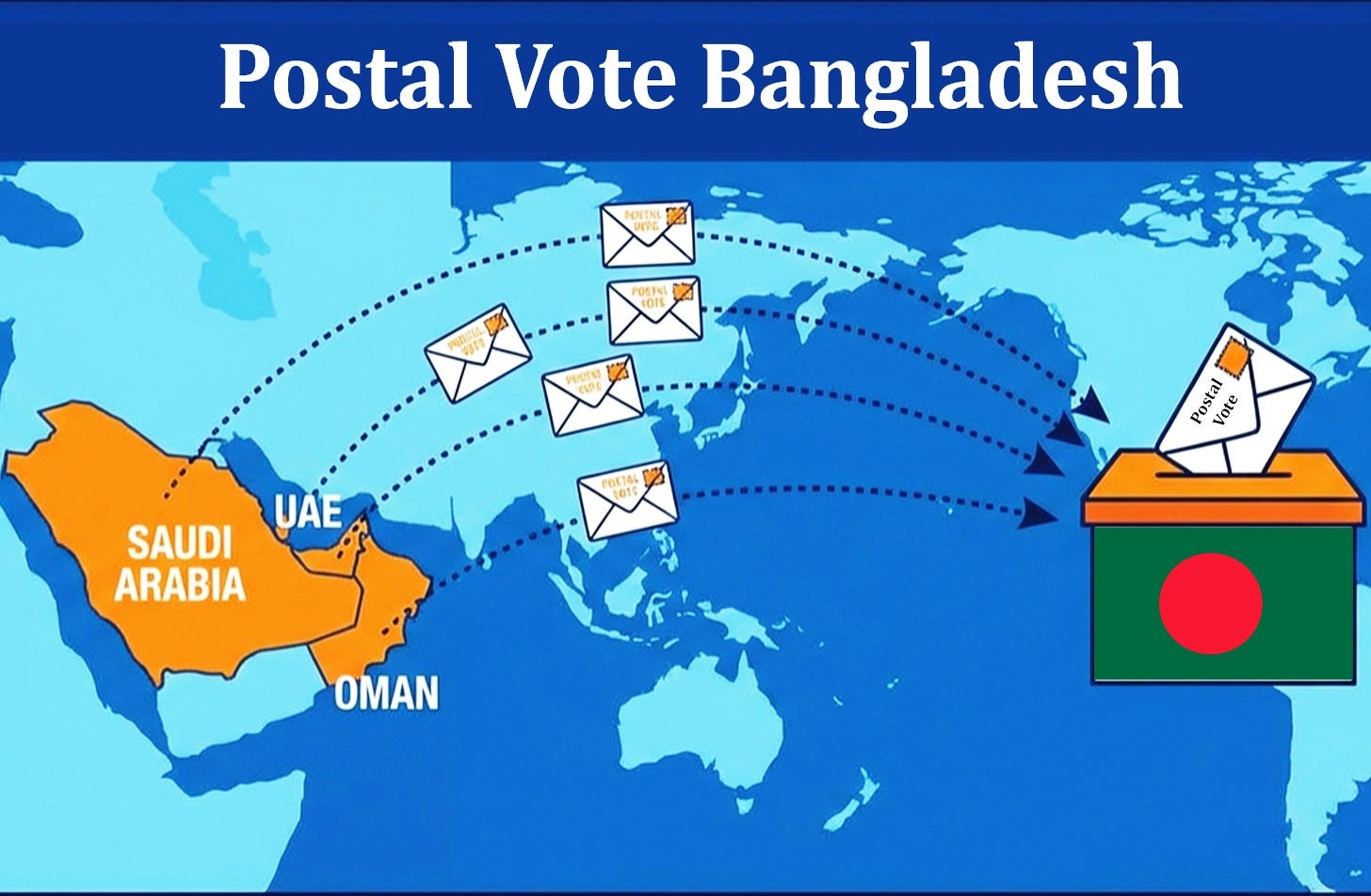
Why Postal Votes Matter
Bangladesh has a history of close election contests. In many seats, candidates have won by fewer than 10,000 votes. In rare cases, just one vote decided the winner. Against this background, the growing number of postal voters raises an important question, can postal ballots change election results? In closely fought races, they clearly can.
Earlier laws allowed postal voting, but few people used it. This time, the EC aimed to create a system that actually works. It consulted experts from Dhaka University, BUET, and MIST, and studied postal voting systems in other countries. This effort led to the creation of the “Postal Vote BD” app, which voters used to register and submit their mailing addresses.
Who Are the Postal Voters?
A total of 1,533,682 voters registered through the app. Of them, 761,140 live inside Bangladesh. These include government officials on election duty and prisoners who are eligible to vote. The rest live abroad, spread across 123 countries.
Saudi Arabia has the highest number of registered postal voters, with nearly 240,000. Malaysia, Qatar, Oman, and the United Arab Emirates follow. Many voters also live in Europe and North America. These numbers reflect Bangladesh’s labor migration patterns and show how a large group of citizens, long excluded from elections, can now take part.
Number of Voters by Constituency
The influence of postal voting becomes clear at the constituency level. Feni-3 tops the list with 16,093 registered postal voters. This is followed by Chattogram-15 with 14,301, Cumilla-10 with 13,977, Noakhali-1 with 13,658, Noakhali-3 with 12,829, Feni-2 with 12,797, Cumilla-1 with 12,583, Sylhet-1 with 12,458, Cumilla-5 with 12,373, Cumilla-6 with 11,943, Chandpur-5 with 11,852, Noakhali-5 with 11,675, Feni-1 with 11,246, and Cumilla-9 with 11,185 registered voters.
There are four constituencies with more than 10,000 registered voters: Cox’s Bazar-3, Noakhali-4, Cumilla-4, and Lakshmipur-2.
There are nine constituencies with more than 9,000 registered voters: Lakshmipur-3, Brahmanbaria-3, Cox’s Bazar-1, Cumilla-3, Sylhet-6, Munshiganj-3, Chandpur-4, Brahmanbaria-4, and Noakhali-2.
There are ten constituencies with more than 8,000 registered voters: Dhaka-8, Munshiganj-1, Chandpur-3, Chandpur-2, Cumilla-1, Cumilla-8, Dhaka-1, Dhaka-18, Brahmanbaria-5, and Rajbari-2.
There are eleven constituencies with more than 7,000 registered voters: Sylhet-5, Chapainawabganj-3, Chandpur-1, Chattogram-2, Dhaka-15, Kishoreganj-2, Cumilla-2, Jashore-2, Jhenaidah-2, Lakshmipur-1, and Khagrachhari (Hill Tracts).
There are twenty-one constituencies with more than 6,000 registered voters: Narsingdi-5, Jashore-3, Chattogram-5, Chattogram-16, Moulvibazar-3, Barishal-5, Shariatpur-2, Narayanganj-3, Chattogram-1, Moulvibazar-1, Kishoreganj-1, Chapainawabganj-1, Dhaka-10, Barguna-1, Mymensingh-4, Satkhira-2, Narsingdi-4, Sylhet-3, Chattogram-10, Madaripur-3, and Dhaka-9.
There are forty-six constituencies with more than 5,000 registered voters. These include Brahmanbaria-2, Dhaka-17, Chattogram-11, Lakshmipur-4, Chattogram-7, Satkhira-1, Munshiganj-2, Faridpur-4, Cumilla-7, Tangail-6, Dhaka-20, Dhaka-13, Chattogram-8, Moulvibazar-2, Sunamganj-5, Dhaka-19, Tangail-8, Jhenaidah-3, Gazipur-4, Tangail-3, Rangamati (Hill Tracts), Chuadanga-1, Dhaka-14, Chattogram-14, Tangail-5, Madaripur-2, Mymensingh-10, Rajshahi-2, Khulna-3, Rangpur-3, Gazipur-2, Manikganj-2, Chuadanga-2, Jashore-5, Brahmanbaria-6, Kishoreganj-6, Chattogram-4, Magura-1, Barishal-2, Netrokona-2, Shariatpur-1, Rajbari-1, Magura-2, Tangail-2, Barguna-2, and Shariatpur-3.
Finally, 176 constituencies have fewer than 5,000 but more than 1,500 registered voters. The lowest registration has been recorded in Bagerhat-3, with 1,595 voters.
So, in dozens of seats, the number of postal voters is large enough to exceed past victory margins. Even constituencies with 5,000 to 9,000 postal voters could see results swing if races remain tight.
Regional Gaps in Participation
District-level data show that Cumilla, Dhaka, Chattogram, and Noakhali lead in postal voter registration. These districts have strong migration links, which helps explain their high numbers. In contrast, districts like Bandarban show very low registration. This difference highlights ongoing inequalities in access to information, technology, and voter engagement.
Democratic Gains and New Challenges
Many see postal voting as a positive step for democracy. Election Commissioner Abul Fazl Md. Sanaullah has said that allowing expatriates to vote strengthens democratic participation. It gives citizens a voice even when they live far from home.
However, the system also faces challenges. Postal delivery can take a long time, especially from distant countries where mail may take up to 28 days. To reduce this risk, postal voters will cast their ballots well before election day so that votes arrive in time to be counted.
How the Voting Process Works
Each postal voter receives two ballots, one for the parliamentary election and one for the July Charter referendum. The ballots do not list candidate names. Instead, voters use the app to match symbols. This approach reduces printing complexity but requires voters to be digitally aware and careful.
The Cost Question
Postal voting also brings financial concerns. The EC estimates the cost at about Tk 700 per voter, with total spending nearing Tk 400 crore. Supporters argue that strengthening democracy justifies the expense. Critics question whether the cost will deliver enough benefit. The final judgment will depend on turnout, transparency, and public trust.
A New Electoral Reality
Postal voting adds a new layer of uncertainty to Bangladesh’s elections. Political parties can no longer focus only on voters inside the country. Expatriate voters now form a powerful group that can influence outcomes. In an election where margins matter, postal votes may help decide who governs Bangladesh next.
About the Author
Shahedur Rahman is the Op-Ed-Editor of The Insighta and a media professional with over 17 years of experience in journalism and editing. He can be reached at rahmankazishahedur@gmail.com
Disclaimer: The views expressed in this article are the author’s own and do not necessarily reflect The Insighta’s editorial stance. However, any errors in the stated facts or figures may be corrected if supported by verifiable evidence.