

Why Jaishankar’s Meeting Was a Win for Tarique Rahman
Jaishankar’s high-profile engagement with Tarique Rahman at Khaleda Zia’s funeral signals a late but meaningful shift: India is widening diplomatic access and hedging its Bangladesh bet.

দিল্লির সাউথ ব্লক বুঝতে শুরু করেছে যে বাংলাদেশ নীতিতে ১৫ বছর এক দলের ওপর অতিনির্ভরতা ছিল ব্যয়বহুল ঝুঁকি। খালেদা জিয়ার জানাজায় জয়শঙ্করের প্রকাশ্যে তারেক রহমানকে মোদির শোকবার্তা দেওয়া শুধু সৌজন্য নয়; এটি কূটনৈতিক ‘বিকল্প’ বাড়ানোর স্পষ্ট বার্তা। এতে তারেকের রাজনৈতিক বৈধতা ও নির্বাচনী অবস্থান শক্ত হলো, আর ভারতেরও বদলে যাওয়া বাস্তবতা মেনে নেওয়ার নতুন জানালা খুলল।
The South Block in New Delhi is reckoning with a costly fact: it should not have put all its eggs in one basket by backing and lobbying for an authoritarian regime for 15 years.
In a gesture of goodwill, India sent its most senior diplomat to Begum Khaleda Zia’s funeral when neither Pakistan nor China, India’s peer competitors in the regional influence game, nor any major OIC country did so. New Delhi now appears to be in portfolio-diversification mode. The diplomacy around the funeral was more than ceremonial. India did something it had long avoided doing so visibly: it widened its diplomatic access.
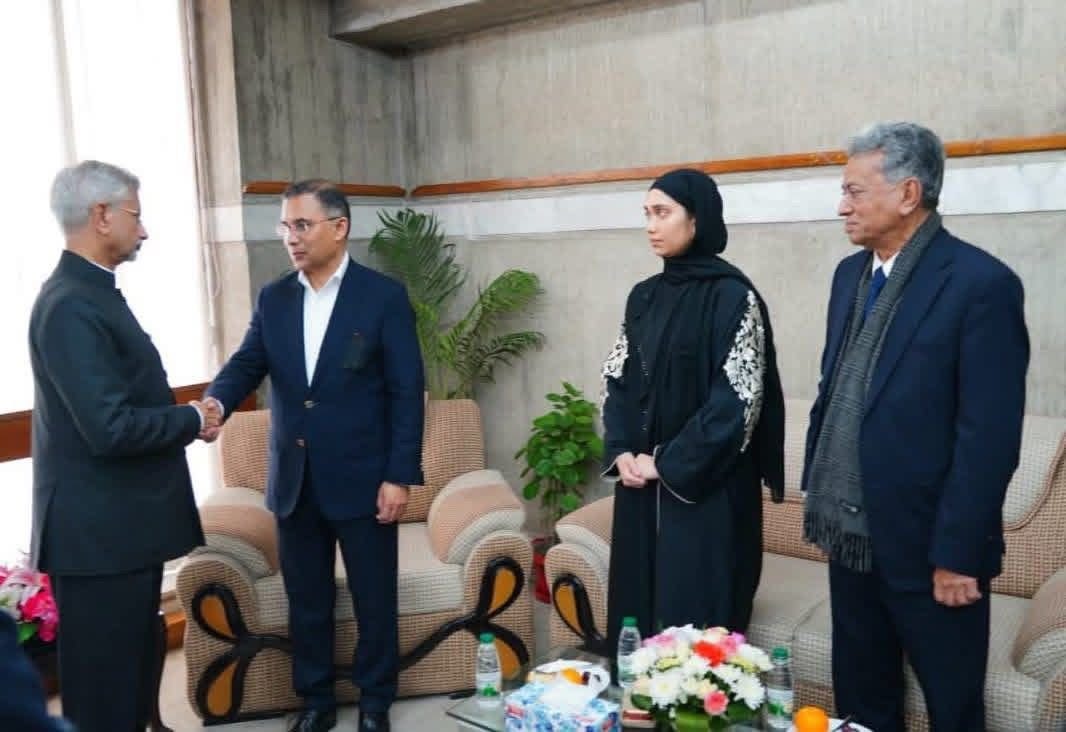
When India’s foreign-policy chief, S. Jaishankar, handed Tarique Rahman a condolence letter from Prime Minister Modi at Khaleda Zia’s funeral– a tableau that said, louder than the text itself–that New Delhi is ready to step out of its Awami-only lane in Dhaka. In South Asian diplomacy, where messages are carried as much by the messenger as by the message, the choice of emissary mattered. Overall, this was a political win for Tarique Rahman and a pragmatic hedge for Delhi.
A Political Win in Symbolic Diplomacy
For Tarique Rahman, the meeting is a clear political victory in symbolic diplomacy for three reasons.
First, diplomatic visibility and legitimacy. This was not a corridor handshake. It was a formal engagement in which India’s top foreign policy official delivered a personal letter from the Indian prime minister. That alone signals recognition of Mr. Rahman’s political stature beyond Bangladesh’s domestic arena. India’s gestures are read closely by other governments, investors, and regional bureaucracies. When India chooses to engage a Bangladeshi leader publicly, at this senior level, it communicates seriousness.
Second, soft power and symbolic endorsement. Modi’s message did more than convey condolences. It praised Khaleda Zia’s role in India–Bangladesh ties, framed her legacy as foundational, and implicitly cast Tarique Rahman as the inheritor of that diplomatic lineage. For a political leader approaching an election, that kind of symbolic alignment matters. It strengthens the argument that he represents continuity in Bangladesh’s external posture and has regional relevance, not merely domestic salience.
Third, strategic positioning ahead of elections. Timing amplified everything. Tarique Rahman returned to Bangladesh in late December 2025 after nearly 17 years in exile, re-entering a highly charged environment with parliamentary elections approaching in February 2026. The meeting came days after his widely publicized return. India’s respectful, high-profile gesture helps blunt any storyline that he is diplomatically sidelined. It also signals that key regional capitals are prepared to engage him directly, in visible settings, which can shape domestic perceptions among voters who care about Bangladesh’s international standing.
None of this necessarily signifies a doctrinal course correction in India’s Bangladesh policy. And it does not mean that longstanding issues are resolved. Far from it. India’s strategic instincts, its security establishment’s preferences, and its habit of seeking maximum influence in its near abroad will not vanish because of one condolence meeting.
But the reckoning still matters.
Bangladesh Isn’t Optional for India
Bangladesh is not an optional neighbor. The main asset India has relied on since Bangladesh’s birth, the Awami League, is facing an existential threat. A workable relationship with Dhaka in the absence of the Awami League, even if transactional and occasionally tense, is not a luxury. It is a baseline requirement for stability on both sides.
When Delhi chains itself to one faction in Dhaka, it invites blowback and loses room to maneuver the border, trade, and security levers that keep the neighborhood calm. The fix is simple but disciplined: keep a working line to whoever rules while cementing systems, river-water talks, tariff-free corridors, grid links, crisis hotlines, that outlive any government. Influence built on institutions, not personalities, survives the next election and the one after.
If the South Block is finally internalizing that lesson, it is arriving late. But in geopolitics, late learning is still learning.
Better late than never.
About the Author
Nazmus Sakib is a Lewis Lecturer of Political Science at the University of Kentucky. His research focuses on international security, South Asia, and civil–military relations. He can be reached at nazmus.sakib@uky.edu
Disclaimer: The views expressed in this article are the author’s own and do not necessarily reflect The Insighta’s editorial stance. However, any errors in the stated facts or figures may be corrected if supported by verifiable evidence. | A guest post by
|