

"Never a Client State": Dhaka's India Policy Shifts
Dhaka called Hasina's Delhi address an affront to its sovereignty and demanded her return. Its sharpest reaction in two years came on an evening its own citizens were barred from hearing the speech

দুই বছর পর প্রথমবার প্রকাশ্যে এলেন শেখ হাসিনা—নয়াদিল্লি থেকে ভার্চুয়াল ভাষণে ঘোষণা দিলেন দেশে ফেরার। ঢাকা একে দেশের সার্বভৌমত্বের প্রতি অবমাননা বলে তীব্র নিন্দা জানিয়েছে এবং ২০১৩ সালের চুক্তির আওতায় হাসিনাকে প্রত্যর্পণের দাবি পুনর্ব্যক্ত করেছে। ভারত বলছে, বেসরকারি আয়োজনে তাদের কোনো ভূমিকা নেই। কিন্তু একই সন্ধ্যায় দেশের গণমাধ্যমে ভাষণটি প্রচারে নিষেধাজ্ঞাও দেয়া হয়।
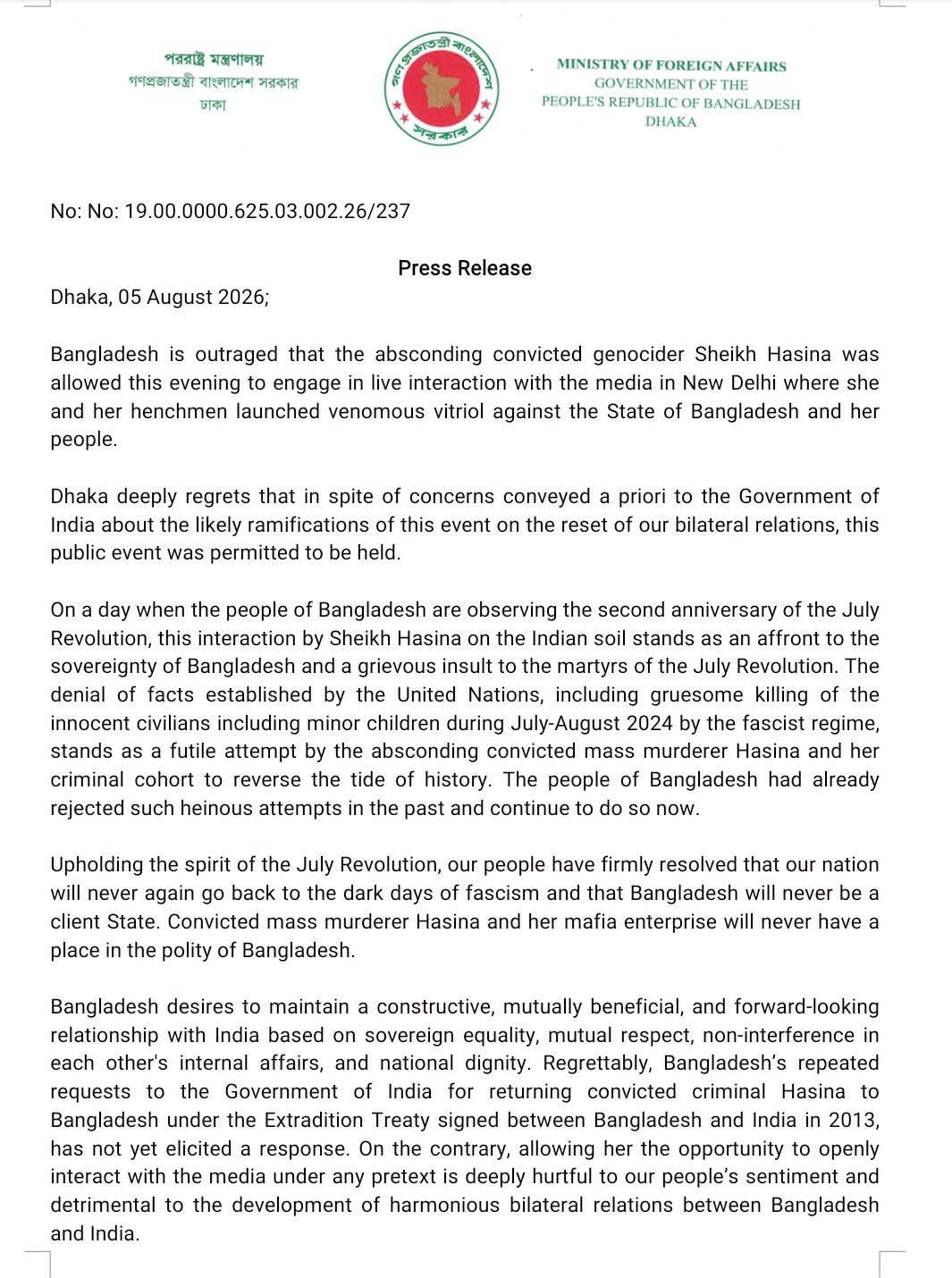
Bangladesh’s Ministry of Foreign Affairs said Wednesday evening it was “outraged” that convicted former Prime Minister Sheikh Hasina had been allowed to address journalists from New Delhi on the second anniversary of her government’s fall, calling the event an affront to the sovereignty of Bangladesh and a grievous insult to the martyrs of the July Revolution.
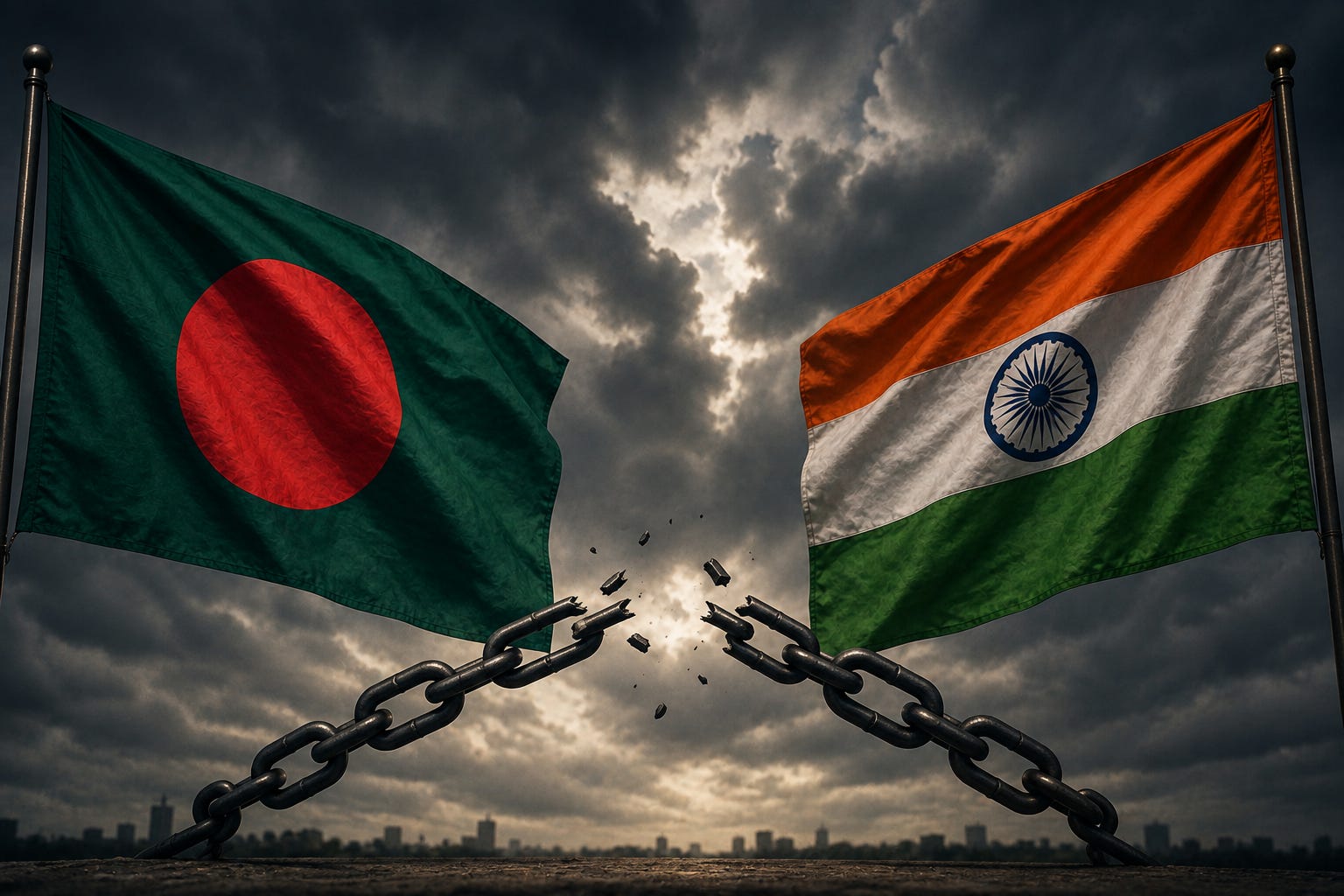
The statement’s sharpest line was aimed past Hasina and at her hosts. Bangladesh, it said, will never again go back to the dark days of fascism, and will never be a client State, a formulation with no obvious precedent in recent Bangladeshi statements on India, and one that recasts a recurring diplomatic irritant as a question of national standing.
Alongside it came the demand Dhaka has made without result since August 2024: that India return Hasina under the extradition treaty the two countries signed in 2013. The ministry noted pointedly that repeated requests have not elicited a response. Allowing a convicted former leader to address the media under any pretext, it said, is deeply hurtful to public sentiment and damaging to bilateral ties.
The ministry also said Bangladesh had conveyed its concerns to India in advance about the event’s likely effect on efforts to reset relations, and that the program was permitted to proceed regardless. Hasina’s denial of facts established by the United Nations, it said, was a futile attempt to reverse the tide of history. A U.N. report found that as many as 1,400 people may have been killed between July 15 and Aug. 5, 2024, most by gunfire from security forces.
A harder line, and where it comes from
What distinguishes Wednesday’s statement is not that Dhaka objected — it has objected to every one of Hasina’s addresses from Indian soil — but that it objected on the record, in this language, and at this moment. Previous protests were delivered through summons and notes verbale. This one was published.
Dr. Nazmus Sakib, an international relations scholar at the University of Kentucky, told The Insighta that the tone reflects what the July Revolution changed. Unlike its predecessor, he said, the current government holds an electoral mandate, and one of the movement’s central aspirations was a Bangladesh that is genuinely sovereign, an aspiration the statement is written to express.
Sakib argued that the confidence also has a material basis. Under Prime Minister Tarique Rahman, he said, Bangladesh has widened its foreign policy by deepening engagement with the United States and China, allowing Dhaka to deal with major economic and security partners directly rather than through India as an intermediary.
He described the July uprising as having become a red line in Bangladesh’s political settlement, with broad agreement among parties in Parliament that no one accused of mass killings should escape investigation, trial and, on conviction, punishment.
That consensus is real, though it is worth noting what shapes it: the Awami League’s registration was suspended before the February election and the party did not contest it, so the parliamentary agreement Sakib describes is one reached in its absence.
What was said, and where
The event was not a news conference Hasina convened. She appeared by video link before the Foreign Correspondents’ Club of South Asia, at a session billed as her homecoming, joined by her son Sajeeb Wazed Joy and Awami League figures including former Education Minister Mohibul Hasan Chowdhury Nowfel.
Hasina, 78, used the address to announce that she intends to return to Bangladesh despite a death sentence handed down in absentia by a Dhaka tribunal in November, telling the audience that detention or imprisonment would not override what she called her duty to the people. She defended her government’s handling of the July–August 2024 unrest and rejected the characterization of the protests as a peaceful student movement, a direct challenge to the founding account of the government that replaced her.
India’s position was stated a day before Dhaka’s protest, not after it. At a briefing Tuesday, Ministry of External Affairs spokesman Randhir Jaiswal said the Indian government had no involvement in the event and did not endorse views expressed there, describing the organizer as a private media entity. Dhaka had raised its concerns Monday, when Foreign Affairs Adviser Humayun Kabir met India’s newly posted High Commissioner, Dinesh Trivedi.
The sequence matters. Dhaka’s grievance is not that India staged the event but that it declined to prevent it, a distinction New Delhi has used consistently, and one that leaves the underlying dispute exactly where it was.
The extradition question stays frozen
By naming the 2013 treaty and publicly recording India’s silence on it, Dhaka has kept the demand on the bilateral agenda rather than letting it lapse into a private grievance. New Delhi has said the matter is moving through its legal processes.
The pattern is now established: Hasina speaks from India, Dhaka protests, India disclaims involvement, the treaty request goes unanswered. An audio address in January drew a comparable protest and the same outcome. The variable this time is the calendar. Rahman, who took office in February after his party’s election victory, is expected in New Delhi for a BRICS summit next month, which means the reset his government has pursued since February now carries an unresolved extradition claim into a face-to-face meeting.
The ban at home
The element Wednesday’s statement does not address is what Dhaka did within its own borders. Ahead of the address, Information and Broadcasting Adviser Zahed Ur Rahman said announcing or publishing the speech would violate laws prohibiting the broadcast of Hasina’s statements inside Bangladesh, and domestic outlets were barred from airing it. The Awami League said the measure was intended to intimidate journalists.
The government’s position is that it is denying a convicted person a platform, not restricting coverage. The practical effect, however, is that Bangladeshis were the audience least able to hear a speech their own government spent the evening rebutting, while it streamed freely everywhere else. A prohibition that stops at the border does not determine whether a speech is heard — only who hears it secondhand.
What to watch
Three questions follow. Whether India responds to the extradition request before the BRICS meeting or continues to treat it as a matter for its courts. Whether Hasina’s stated plan to return in December is an intention or a mobilizing message to a leadership largely in exile. And whether Wednesday’s broadcast restriction proves to be an exception or a precedent.
A government that describes itself as restoring democratic norms after fifteen years of their erosion invites scrutiny of how it handles speech it finds intolerable. On the evidence of one evening, it answered that question twice — once toward Delhi, and once toward its own newsrooms.