


জুলাই বিপ্লবের দুই বছর পার হয়ে গেলেও রাষ্ট্রের মূল কাঠামোগত সংস্কার এখনো অনেকাংশে অধরা রয়ে গেছে। ২০২৪ সালের আগস্টে শেখ হাসিনার পতনের পর অন্তর্বর্তীকালীন সরকার একটি অবাধ ও নিরপেক্ষ নির্বাচন পরিচালনা, অর্থ পাচার রোধে ব্যাংকিং খাতে ফরেনসিক অডিট এবং চীন, যুক্তরাষ্ট্র, পাকিস্তান ও তুরস্কের সাথে ভারসাম্যপূর্ণ এক নতুন বৈদেশিক নীতি বা ‘মাল্টি-অ্যালাইনমেন্ট’ পরিচালনায় উল্লেখযোগ্য সাফল্য দেখিয়েছে। তবে পাশাপাশি ব্যাংক পুনরুদ্ধার আইনের মাধ্যমে পুরোনো প্রভাবশালী গোষ্ঠীকে ছাড় দেয়া, বিরোধী বা সমালোচকদের ওপর দমন-পীড়ন অব্যাহত রাখা এবং গণভোটে জয়ী ‘জুলাই জাতীয় সনদ’ বাস্তবায়নে কার্যকর পদক্ষেপ না নেয়া নির্দেশ করে —স্বৈরাচারী ব্যবস্থার অবসান ঘটলেও বিপ্লবের মূল সংস্কার এজেন্ডা এখনো থমকে আছে।
Two years ago this July, a student-led protest against a discriminatory civil service quota grew, over 36 days, into the mass uprising that ended Sheik Hasina’s fifteen-year rule. She fled to India on August 5, 2024. Bangladesh now marks that date annually as July Mass Uprising Day, and as the country approaches a third anniversary, the balance sheet is coming into sharper focus: the uprising has produced real, internationally verified gains on the political and diplomatic fronts, but it has not yet delivered the structural state reform2-month revolution for which it was fought.
The End of an Authoritarian Order
The clearest achievement is the one the uprising set out to deliver. Hasina, who spent fifteen years hollowing out the judiciary, the election commission, and the security services, now faces a death sentence handed down in absentia for ordering the killing of protesters, and remains the subject of an unresolved extradition standoff with India. Accordingly, the model of personalized one-party dominance that defined the Awami League era has been broken, at least for now.
A Credible Election, A Cautious Military
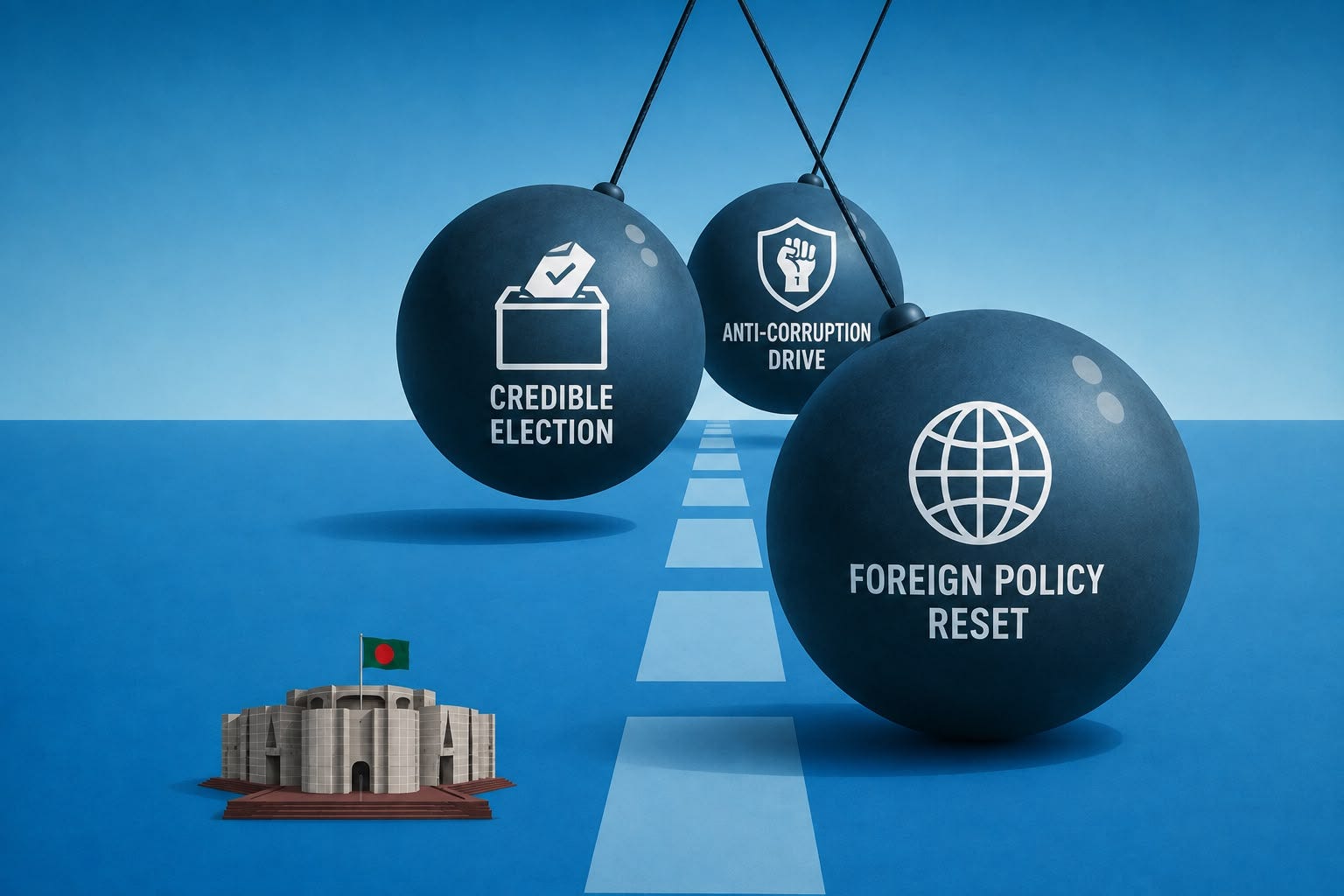
The more consequential test for Bangladesh’s democratic trajectory was whether the interim government led by Nobel laureate Muhammad Yunus could deliver a genuinely competitive election — and by most independent accounts, it did. The European Union’s observation mission, deployed in full for the first time since 2008, described the February 12, 2026 parliamentary poll as credible and competently managed. The International Republican Institute called it an important step forward for the country’s democratic transition, and the Carnegie Endowment’s South Asia Program now counts it among only a handful of Bangladeshi elections since 1971 considered genuinely free of coercion. Analysts have also credited the military’s restraint: General Waker-uz-Zaman kept the armed forces entirely out of the contest, a notable data point in a country that has seen four successful military takeovers and dozens of attempted ones since independence. As a result, Tarique Rahman’s Bangladesh Nationalist Party won a two-thirds majority, forming the government in February on what outside observers broadly regard as a fair mandate.
Confronting a Plundered Financial System
The interim government’s most consequential structural intervention was ordering forensic audits of the banking sector, which had been hollowed out under Hasina. Those audits found non-performing loans had reached roughly 35 percent of all outstanding lending — a scale of rot that had been concealed for years. From there, Bangladesh Bank Governor Ahsan H. Mansur pushed through mergers of distressed Shariah-based banks, asset-quality reviews conducted by international auditors, and amendments to the Bank Companies Act and the Money Laundering Act. Rahman himself told parliament that an estimated $234 billion was laundered out of the country during the Awami League years; his government’s asset-recovery task force says it has frozen roughly Tk 76,000 crore, or about $6.4 billion, tied to Hasina, her family, and politically connected conglomerates including S Alam Group, Beximco, and Bashundhara.
That reform drive, however, has already reversed in a notable way. In April, parliament quietly passed a Bank Resolution Act allowing the former owners of collapsed banks to reclaim control for just 7.5 percent of the funds Bangladesh Bank injected to keep those institutions solvent, with the remainder repaid over two years at modest interest. As a result, financial-press editorial boards in Dhaka have called it a lifeline for the same networks the revolution was meant to dislodge — an early signal that the government’s appetite for structural reform may not outlast political convenience.
A Foreign Policy Reset
Where the new government has moved most decisively is diplomacy. Hasina’s Bangladesh leaned almost exclusively on New Delhi; Rahman has instead pursued what regional analysts describe as genuine multi-alignment. His first overseas trip as premier took him to Malaysia and then Beijing, where a June 2026 visit produced fifteen memoranda of understanding and roughly $300 million in Chinese grants, along with a proposed foreign-and-defence “2+2” dialogue — prompting some China watchers to describe it as a historic pivot, though Rahman himself has framed it as pragmatic “Bangladesh First” diplomacy rather than exclusive alignment with any single power.
Ties with Washington — long clouded by reports of a personal entry restriction tied to Rahman’s 2008-era FBI dossier, a claim that has circulated in Bangladeshi and Indian media citing unnamed diplomatic sources but has not been confirmed by any U.S. government authority — have warmed markedly in recent weeks. The United States upgraded its Bangladesh travel advisory from “Reconsider Travel” to “Exercise Increased Caution” in early August, and during a three-day visit to Dhaka, U.S. Special Envoy for South and Central Asia Sergio Gor said Washington holds Rahman’s leadership in “strong confidence”. Rahman is now scheduled to travel to New York in September to address the 81st UN General Assembly — his first visit to the United States since taking office, timed to coincide with Bangladeshi Foreign Minister Khalilur Rahman’s turn as UNGA president. Dhaka has moved quickly to translate the diplomatic thaw into economic substance: the Prime Minister’s Office announced that 45 senior executives from 25 leading American companies would visit Bangladesh in mid-August to explore investment opportunities, following Rahman’s own appeal to Gor for greater U.S. investment in agriculture, warehousing, and information technology. Dhaka has simultaneously drawn closer to Islamabad, resuming direct flights and easing visa procedures after years of Hasina-era estrangement, and to Ankara, where Turkey and Bangladesh have agreed to jointly manufacture combat drones at a planned factory in Bogura. Most recently, Dhaka joined a fourteen-nation, Saudi-led maritime defense alliance formed to protect shipping through the Red Sea and the Bab al-Mandeb Strait — a hedge that places Bangladesh alongside Gulf and NATO-adjacent partners on a live regional security question for the first time. Taken together, it is a foreign policy portfolio diversified across Beijing, Washington, Islamabad, Ankara, and Riyadh simultaneously — a marked departure from the India-centric alignment of the previous fifteen years, though one that has come with its own friction, as Delhi watches the recalibration warily.
Accountability, Selectively Applied
Domestic accountability has followed a similar pattern to the banking file: real, but unevenly and at times crudely executed. Former chief election commissioners Nurul Huda and Habibul Awal were arrested on charges tied to manipulating prior elections, alongside former army officers implicated in enforced disappearances dating to the 2007–09 caretaker period. But Human Rights Watch has also documented arrests of ordinary citizens over social-media posts critical of the new government, as well as mob assaults on former officials preceding their formal arrest. That continuity with the repressive toolkit the uprising was meant to dismantle, not simply redirect, is hard to miss. In addition, EU observers, even while praising the February vote, flagged the marginal presence of women candidates and the continued underrepresentation of indigenous communities and religious minorities in the new parliament — an inclusion deficit that predates Hasina and has outlasted her.
The Unfinished State Reform
The sharpest gap between rhetoric and record concerns the demand that has always been central to the movement: reforming the state itself, not merely replacing those who run it. In the referendum held alongside the February election, nearly 68 percent of voters endorsed the July National Charter, authorizing parliament to sit as a constituent assembly and legislate structural reform. On taking office, however, Rahman’s government declined to have its members take the oath as part of the Constitution Reform Council, withholding effect from the referendum result it had just won. Meanwhile, the National Citizen Party, the political vehicle born directly out of the 2024 protests, has fractured over an electoral alliance with Jamaat-e-Islami. That reinforces a suspicion voiced by many original protesters: that their uprising risks being absorbed by older political forces, Islamist and secular alike, rather than translated into new institutions. A bomb blast at an NCP rally on this July’s anniversary march, and Hasina’s own public vow to return to Bangladesh before year’s end, underscore how contested the post-uprising settlement remains.
Looking Ahead
Judged against the narrowest goal — removing an entrenched authoritarian and holding a credible election — the July Revolution’s record compares favorably with most transitions of its kind at the two-year mark, and Rahman’s early foreign policy pivot has given Dhaka more room to maneuver between Beijing, Washington, and the Gulf than it has had in a generation. Judged against the movement’s deeper aspiration — institutions no longer dependent on who happens to hold power — the record is more precarious: a referendum result sitting unimplemented, a banking law that rewards the networks it was meant to punish, and a governing party that has so far found it easier to inherit the state than to rebuild it. In sum, the revolution has changed Bangladesh’s rulers more decisively than it has changed Bangladesh’s state.
That verdict will not be settled by this anniversary or the next. Insulating the election commission, preventing the banking sector’s recapture by its former owners, and subordinating the security services to the courts rather than to whichever party holds office are generational undertakings, not a single term’s mandate. Ultimately, whether Rahman’s government treats the July Charter as a binding constraint on itself or as a slogan it has already outgrown will determine how the July Revolution is remembered — as the uprising that changed Bangladesh’s rulers, or the one that changed its state.
Writer: The author is a security analyst and currently serving as an Assistant Professor at the State University of New York-Dutchess and Executive Director of Bangladesh Institute of Development and Secu.Disclaimer: The views expressed in this article are the authors' own and do not necessarily reflect The Insighta's editorial stance. However, any errors in the stated facts or figures may be corrected if supported by verifiable evidence.
