

Govern the U.S. Trade Deal, Don't Grieve It - The Bengal Council
The agreement sparked outrage over 131 obligations. A new Bengal Council brief asks a different question: what if the real risk isn't the deal, but failing to govern it well?

ওয়াশিংটনভিত্তিক থিঙ্ক ট্যাঙ্ক দ্য বেঙ্গল কাউন্সিলের সদ্য প্রকাশিত পলিসি ব্রিফ বলছে, যুক্তরাষ্ট্রের সঙ্গে বাণিজ্য চুক্তি থেকে সরে আসা নয়, বরং কৌশলগতভাবে বাস্তবায়নই বাংলাদেশের জন্য সঠিক পথ। প্রতিবেদনটি মার্কিন সুতোয় তৈরি পোশাকের শূন্য-শুল্ক সুবিধাকে বড় সুযোগ হিসেবে দেখছে। চুক্তিটির বৈধতা নিয়ে বিতর্ক নিষ্পত্তিতে সংসদীয় পর্যালোচনাও জরুরী বলে সুপারিশ করেছে বেঙ্গল কাউন্সিল।
WASHINGTON — Five months after Dhaka signed its Agreement on Reciprocal Trade with the United States, the national argument over the deal has settled into two familiar camps: those who see a lifeline for the garment industry and those who see a surrender dressed up as diplomacy. A new policy brief from The Bengal Council, a Washington-based think tank focused on U.S.-Bangladesh relations, suggests both camps are asking the wrong question. The issue, it argues, is no longer whether the agreement was a good bargain — it is whether Bangladesh has the institutions to make it one.
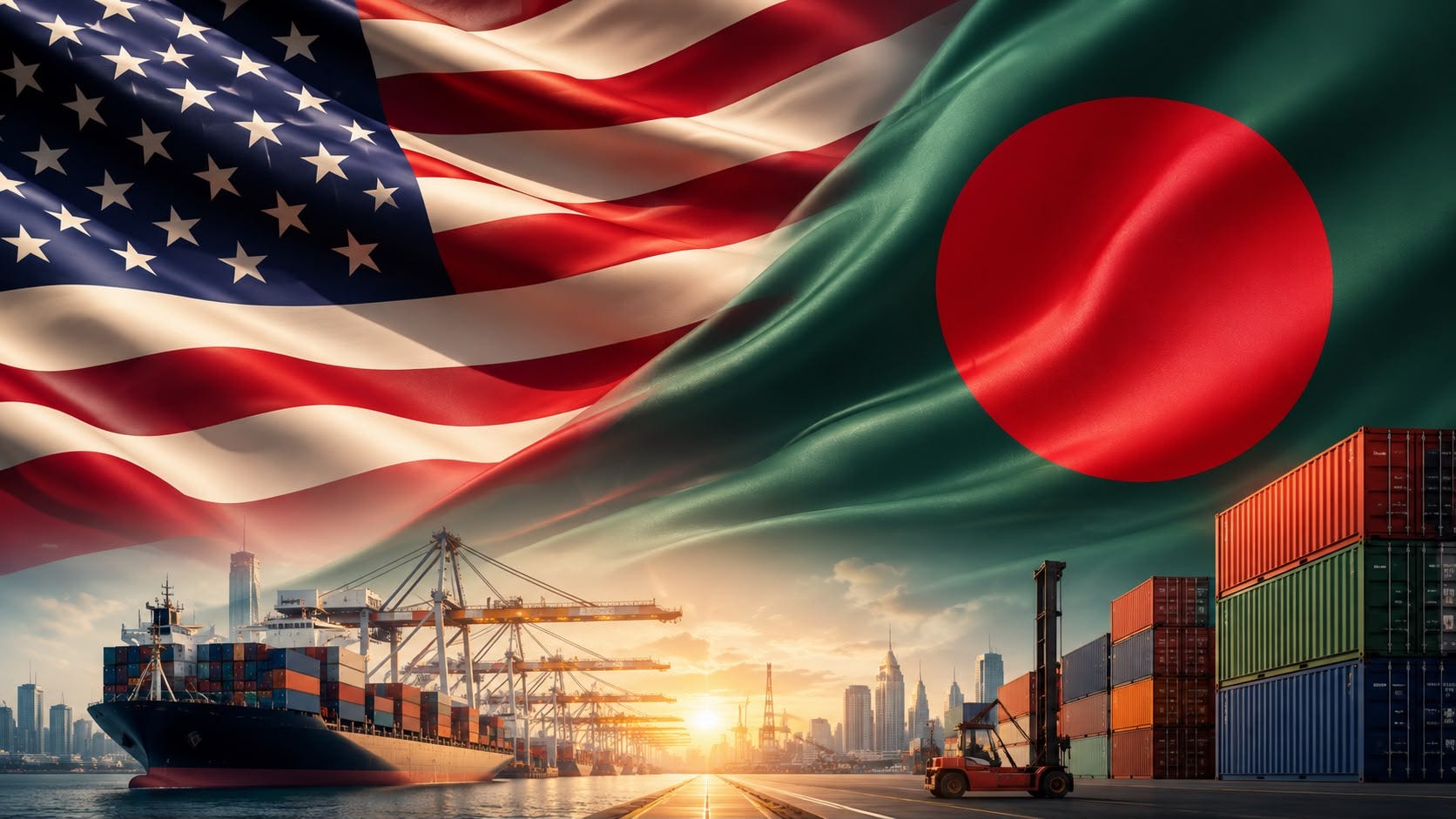
The six-page brief, The Cotton Corridor: Bangladesh’s Reciprocal Trade Agreement with the United States and the Path Forward, released July 5 and announced publicly on July 8, is among the first strategic assessments of the deal signed on Feb. 9. Its central claim is blunt: “The task is not to back out of the deal, but to implement it strategically and manage its risks efficiently.”
The arithmetic of survival
The brief’s case begins with what it calls Bangladesh’s “existential arithmetic.” Ready-made garments earned the country $39.35 billion in fiscal 2024-25, roughly 82 percent of merchandise-export income, and directly employ some four million workers, most of them women. The United States alone took $7.54 billion of those exports. Bangladesh, in the Council’s telling, did not enter negotiations with the second Trump administration to optimize a balanced bargain; it entered them to avoid an economic cliff edge.
Judged against that baseline, the outcome looks less like capitulation than escape. Bangladesh’s reciprocal tariff, first announced at 37 percent in April 2025, was negotiated down to 19 percent, alongside a pathway to zero tariffs for garments made with U.S.-origin cotton and man-made fibers. That places Dhaka roughly level with Cambodia and Indonesia at 19 percent, Vietnam at 20 and India at 18, while the cotton-linked corridor could give Bangladeshi suppliers an edge none of those competitors fully matches. “Zero is not nothing,” the brief observes, in what may become the debate’s most quoted three words.
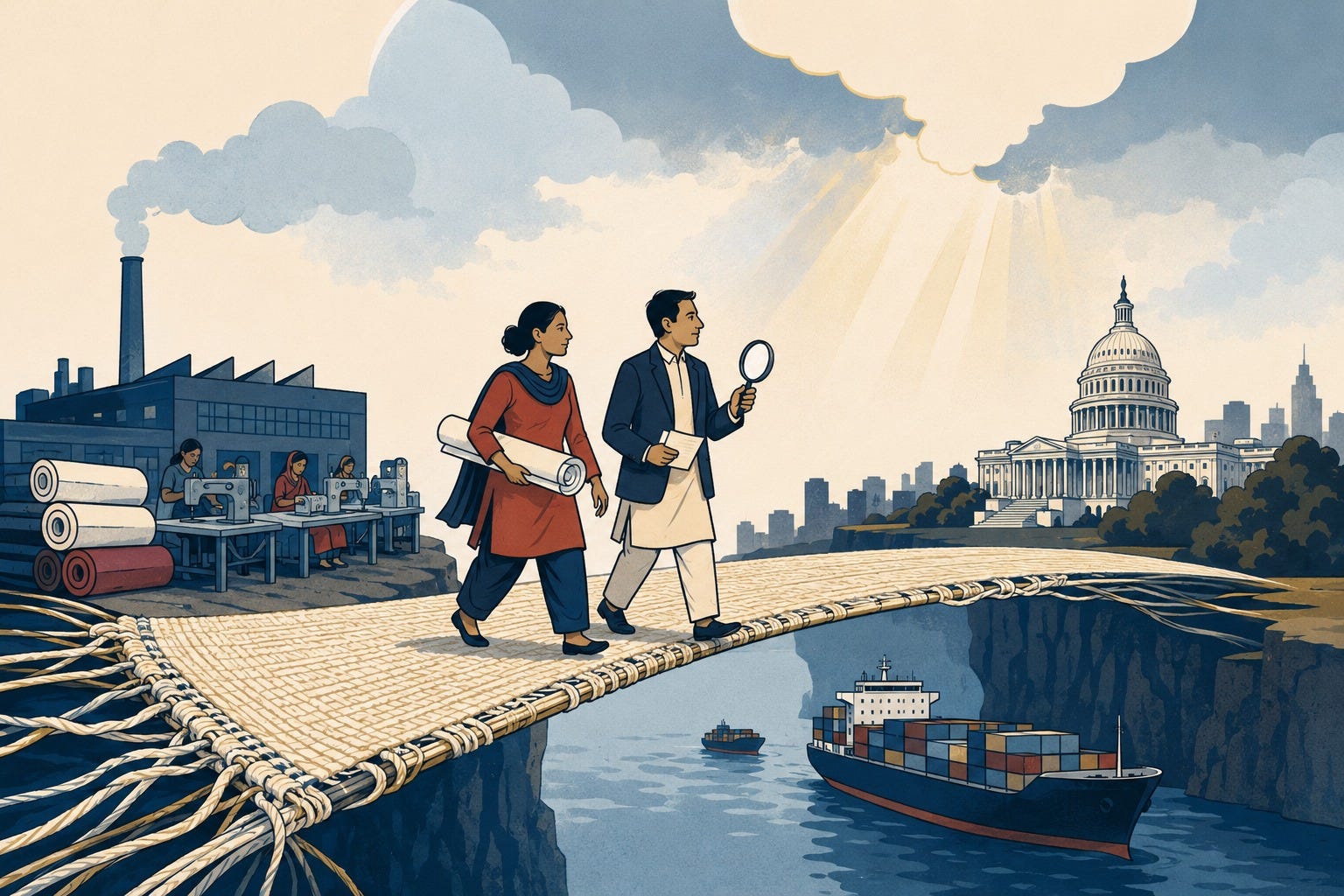
One hundred thirty-one obligations, examined
The Council does not wave away the deal’s critics. It engages directly with the widely cited count, first reported by another Bangladeshi news daily in May, that the text imposes roughly 131 obligations on Bangladesh against six accepted by Washington. But it draws a distinction the public debate has mostly skipped: many contested clauses, including the moratorium on customs duties for electronic transmissions and acceptance of U.S. product standards, appear in materially similar form in Washington’s agreements with Malaysia and Cambodia. They are template, not targeting.
The genuinely demanding provisions, the brief finds, lie elsewhere: restrictions on nuclear procurement, duty-evasion and export-control cooperation requirements, and a clause allowing Washington to terminate the agreement if Bangladesh strikes a deal with a “non-market country” — read, China — that undermines it. These, the Council argues, create “substantial discretion” for the American side and deserve close parliamentary scrutiny rather than rhetorical inflation.
Cotton politics and nervous neighbors
The zero-tariff corridor carries regional consequences. Bangladesh consumes about 8.5 million bales of cotton a year and imports nearly all of it; India supplied $2.7 billion worth in 2024. A wholesale shift toward U.S. cotton, an explicit incentive of the corridor, rattled Indian textile shares the day the deal was announced. The Council contends the economics are workable: U.S. upland cotton has historically traded within 5 to 10 percent of comparable Indian fiber, and the tariff saving on finished garments can outweigh realistic landed-cost differences. Its advice to Dhaka is diplomatic as much as commercial — frame the sourcing shift as economic strategy, not rivalry.
The European Union poses a subtler problem. As Bangladesh pursues GSP+ access and eventual LDC graduation, it must reconcile an American template that treats geographical indications as generic and favors free data flows with a European model built on intellectual-property protection and data sovereignty. The brief urges early legal harmonization before the two frameworks collide.
A deal on shifting legal ground
Perhaps the brief’s most sobering section concerns Washington itself. On Feb. 20, the U.S. Supreme Court ruled that the International Emergency Economic Powers Act did not authorize the president’s reciprocal tariffs; the administration’s stopgap — a global surcharge under Section 122 of the Trade Act — was itself ruled beyond presidential authority by the U.S. Court of International Trade on May 7, though the surcharge survives pending appeal. Neither the legal instrument that produced Bangladesh’s agreement nor its replacement, in other words, stands on secure ground. The Council’s counsel: stay engaged and seek explicit preservation of the cotton corridor as the tariff regime is rebuilt, rather than assume the concessions survive on their own.
A parliament’s first test
The brief’s institutional prescription lands on a legislature unusually green for the task. The February election returned a chamber in which more than two-thirds of members are first-time legislators, a democratic renewal, the Council notes, that coincides with the most complex external trade obligations in the country’s history. Its answer is a formal parliamentary vetting process: a committee review of the text, a floor debate, and a resolution of endorsement, followed by a standing cross-party subcommittee with technical staff to watch the penalty provisions and third-country clauses. Such a process, the brief argues, would settle the legitimacy debate without renegotiation, and signal to Washington that Bangladesh’s commitments carry democratic backing.
Among its eight recommendations, the Council also calls for a sector-wide implementation roadmap from the Ministry of Commerce and the garment manufacturers’ association to operationalize the corridor before regional competitors close the gap, coordination with Malaysia, Cambodia, Vietnam, Thailand and Indonesia to shape the successor tariff framework collectively, and an independent, published impact assessment to discipline the national debate with evidence.
Whether Dhaka takes the advice is another matter. But the brief reframes a debate that has run hot since February: the agreement’s worth will be decided less by the ink of Feb. 9 than by what Bangladesh builds around it — in parliament, in supply chains, and in the patient diplomacy of a relationship the Council insists is a foundation, not a ceiling.
The full policy brief is available at bengalcouncil.org.