

From Lynchings to Rumor Mobs, a Year of Fear for Minorities in India and Bangladesh
From May–Dec 2025, minorities in India and Bangladesh faced violence, hate speech, evictions and rumor attacks. The Insighta logged 100 cases, showing state actions and disinformation deepened fear.

২০২৫ সালের মে-ডিসেম্বর সময়ে ভারত ও বাংলাদেশে ধর্মীয় সংখ্যালঘুরা সহিংসতা, উচ্ছেদ, ঘৃণাসূচক ভাষণ ও গুজবভিত্তিক হামলার মুখে পড়ে। রাষ্ট্রীয় পদক্ষেপ ও সীমান্তপারের অপপ্রচার কীভাবে ভয় ও অবিশ্বাস বাড়িয়েছে, এই প্রতিবেদনে তার ধারাবাহিক চিত্র তুলে ধরা হয়েছে।
Between May and December 2025, religious minorities in India and Bangladesh faced sustained violence, hate speech, legal pressure, and organized misinformation. During this period, The Insighta documented at least 100 major incidents across the two countries. Around 71 of these incidents occurred in India, including repeated cases of mob violence, lynching, cow vigilantism, forced evictions, demolitions, deportations, and open hate speech by political and religious leaders. At least 29 incidents were recorded in Bangladesh, where large-scale physical violence was less frequent but mob attacks triggered by religious allegations and sustained misinformation campaigns posed serious risks to minority communities. Overall, India accounted for most cases of physical violence and state action, while Bangladesh was more heavily affected by rumor-driven violence and cross-border disinformation. Several incidents during the year illustrate the severity of these trends.
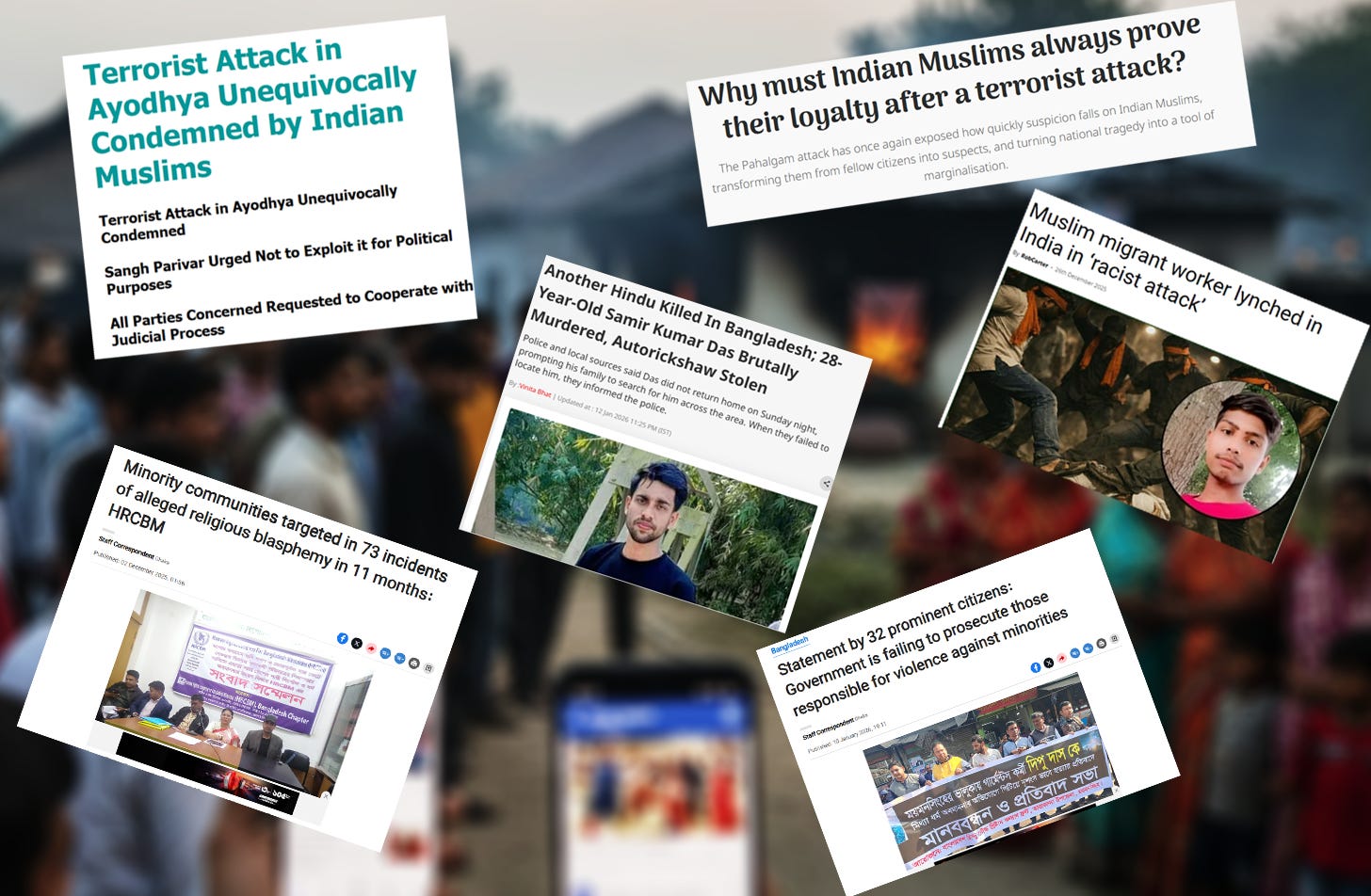
In December 2025, a Hindu man was beaten to death in Bhaluka, Mymensingh, over blasphemy allegations in Bangladesh. In October 2025, senior Indian political leaders made openly communal statements, while Muslim localities in Cuttack, Odisha, were vandalized following a religious procession. In July 2025, demolition drives in Assam displaced thousands of Bengali-speaking Muslims during the monsoon. Earlier, in May 2025, more than 7,000 mostly Muslim homes were demolished in Ahmedabad, and between May 7 and 9, Indian border forces pushed hundreds of Muslims and Rohingya refugees into Bangladesh. These incidents show how violence, state action, and public rhetoric affected minorities in both countries.
This yearly report presents these developments in reverse chronological order, from December back to May 2025, to trace how communal pressure and misinformation evolved and intensified over time. By documenting incidents month by month across India and Bangladesh, the report highlights patterns of physical attacks, hate speech, administrative pressure, symbolic exclusion, and digital propaganda, and shows how online misinformation and on-ground actions together deepened fear, mistrust, and regional instability throughout 2025.
December 2025
December 2025 recorded at least eight major incidents across India and Bangladesh, marked by state actions, communal tension, political statements targeting Muslim institutions, mob violence, attacks and renewed waves of misinformation affecting religious minorities.
In India, government-led actions and public debates continued to affect Muslim communities. Uttar Pradesh launched a statewide operation against alleged “illegal Bangladeshi and Rohingya migrants,” ordering municipal bodies to prepare lists of suspected foreign nationals and directing the establishment of detention centers across administrative divisions. In Karnataka, tensions resurfaced at a government college after Hindu students entered classrooms wearing saffron shawls to protest Muslim girls wearing hijabs. Political rhetoric also intensified, with a BJP MP calling in Parliament for mandatory CCTV surveillance in mosques and madrasas, arguing for uniform security standards across religious institutions. Besides, Bharatiya Janata Party (BJP) leader and Leader of the Opposition in the West Bengal Assembly, Suvendu Adhikari, sparked widespread condemnation after saying Bangladesh should be taught a “lesson like Israel has taught Gaza.”
Alongside these developments, misinformation targeting Bangladesh continued to circulate in Indian media and social media spaces. A viral claim showing a Hindu temple being vandalized in Bangladesh was found to be false, as the video was from Pakistan in 2021. Separately, Indian outlets again pushed the debunked “Greater Bangladesh” narrative, falsely accusing a Bangladeshi activist of promoting territorial expansion, despite repeated fact-checks disproving the claim.
In Bangladesh, the month saw a severe incident of mob violence. In Mymensingh’s Bhaluka upazila, a Hindu man was beaten to death over allegations of blasphemy, and his body was later tied to a tree and set on fire, according to police. Besides, a series of arson attacks targeting the homes of Hindu families took place in Raozan upazila of Chattogram, prompting the authorities to arrest five people and form a “special security team” to ensure safety in the affected areas.
Overall, December reflected a continued regional pattern of state pressure, hostile political narratives, mob violence, attacks on minorities and cross-border misinformation, all contributing to fear, mistrust, and strained communal relations in both India and Bangladesh.
November 2025
November recorded 11 notable incidents involving hate speech, intimidation, legal pressure, and misinformation. Extreme rhetoric, symbolic state actions, mob pressure, and false narratives deepened communal anxiety.
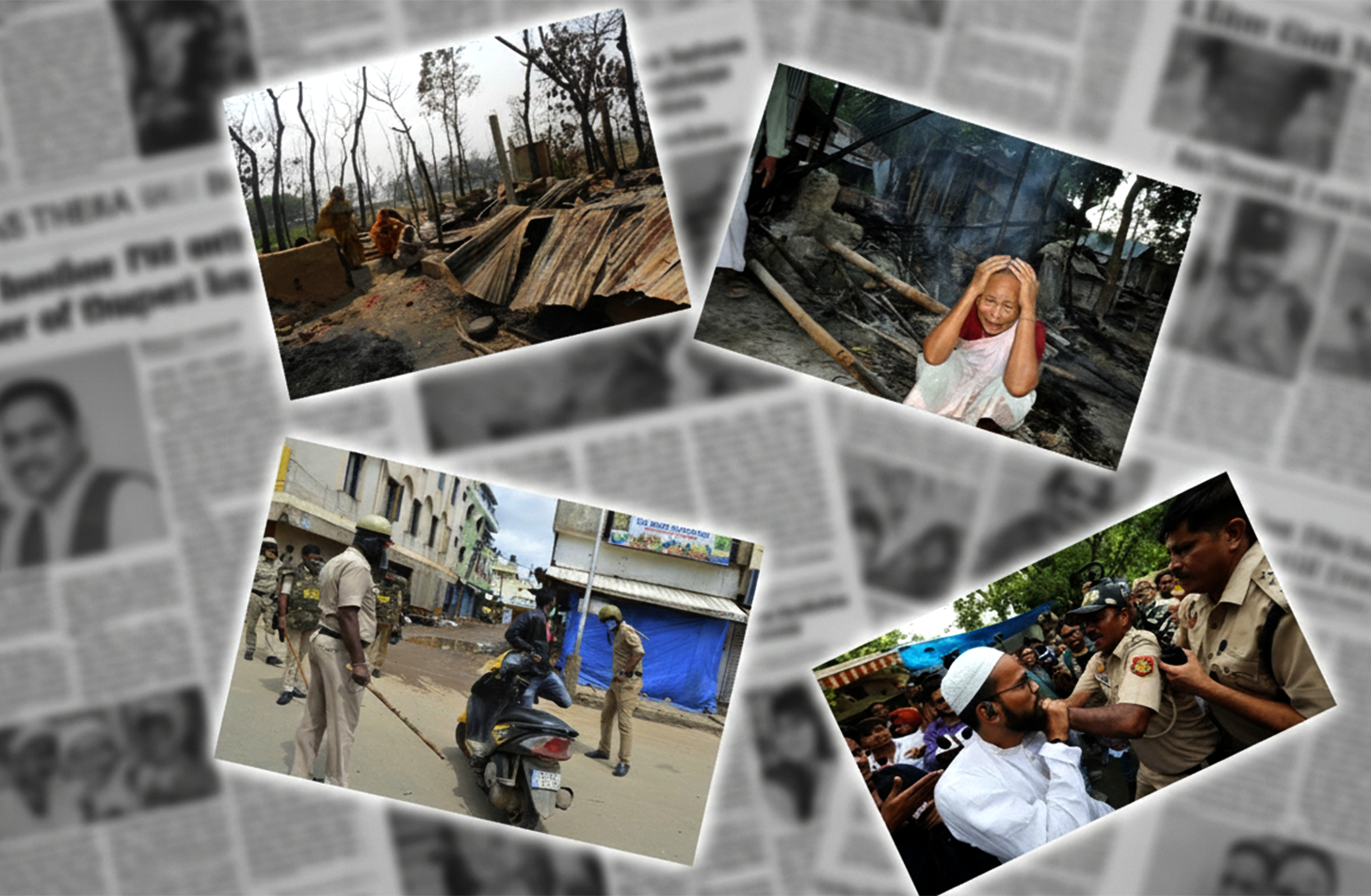
In India, Hindutva leaders openly called for violence and exclusion. Senior figures like Tulika Sharma and Yati Narsinghanand demanded a Hindu-only nation and military attacks on Muslim educational institutions. Christians in Haryana were allegedly forced by mobs to renounce their faith and burn holy books. Muslim religious practices faced legal action, including life sentences for three men convicted under cow slaughter laws. The state also took communal steps, such as renaming Islampur to Ishwarpur in Maharashtra.
In Bangladesh, misinformation dominated. Viral claims about a private militia in Dhaka, a temple fire in Kushtia, and other alleged communal threats circulated by Indian media and social media accounts were later found false by independent fact-checkers.
October 2025
October recorded at least 11 major incidents of hate speech, violence, and misinformation targeting religious minorities. The month combined on-ground attacks, inflammatory political rhetoric, and digital disinformation, heightening communal tension.
In India, Christians in Chhattisgarh were denied burial rights as villages discussed church demolitions. Muslim localities in Cuttack were vandalized by Hindutva mobs after communal clashes linked to a religious procession. Two journalists were booked after reporting that a Muslim woman was denied medical treatment due to her faith. Senior political leaders made openly communal remarks. Home Minister Amit Shah linked Muslim population growth to “infiltration,” BJP leader Raghvendra Pratap Singh urged Hindu youths to kidnap Muslim girls, and Uttarakhand CM Pushkar Singh Dhami labeled Muslims as “land jihadis” while announcing crackdowns on madrasas and conversions. A Muslim minor girl faced mob intimidation after remarks on cow slaughter went viral.
In Bangladesh, the wave of misinformation continued. False narratives included a communal murder of a Hindu policewoman, anti-Hindu slogans by madrasa students, and Dr. Muhammad Yunus gifting a “Greater Bangladesh” flag. Another viral video claiming a Hindu youth was killed by Muslims in Bangladesh was traced to Nepal, exposing cross-border misinformation.
September 2025
September saw at least 15 major incidents of disinformation, hate-driven propaganda, and communal targeting across Bangladesh and India. Fabricated communal claims, recycled images, misleading statistics, and extremist rhetoric deepened mistrust and polarization.
In Bangladesh, false narratives circulated about killings in Chattogram and Khulna, idol vandalism in Joypurhat, alleged rape and murder of Hindu girls, and rumors of Muslims praying inside temples. Police and fact-checkers confirmed most were old cases, private disputes, suicides, or misrepresented events with no communal link. Universities and public institutions were targeted by misinformation, including false claims of mandatory hijab at Dhaka University and distorted nationwide crime statistics portraying violence as directed specifically at Hindus.
In India, extremist rhetoric and violence continued. Bajrang Dal activists attacked Christian worshippers in Chhattisgarh, and an imam in Uttar Pradesh was assaulted for refusing to chant a religious slogan. Hindutva leaders openly called for a Hindu-only nation. Indian media and political platforms amplified misinformation, including false reports on Khagrachhari violence and misidentification of victims’ religious identities.
August 2025
In August, The Insighta documented 15 major incidents of misinformation, propaganda, and communal targeting across India and Bangladesh. Nine originated in India, mainly involving attacks on Muslims and Christians and misleading narratives about Bangladesh, while six occurred in Bangladesh, amplified by pro-Hindutva networks.
The month revealed a clear pattern of fabricated stories inflaming communal tensions. False claims included a “Greater Bangladesh” map, alleged Jizya tax on Hindus in Natore, fake reports of killings in Rangpur, Khulna, and Rajshahi, and exaggerated allegations of mass rape of minority women. Most claims were later debunked by police, fact-checkers, and official sources.
In India, mob violence and intimidation continued alongside online disinformation. Muslim men were assaulted by cow vigilantes in West Bengal and Bajrang Dal members in Uttar Pradesh, while Christian worshippers in Bihar were attacked during Sunday prayers. In Assam, a maktab was demolished, and a Muslim teacher was threatened and labeled “Bangladeshi,” showing the overlap between communal profiling and state-backed actions.
Several incidents recycled old images and videos to falsely depict “communal violence” in Bangladesh, reinforcing narratives portraying the country as unsafe for Hindus. Indian media and political figures amplified misleading claims about cultural exhibitions, religious sites, women’s education, and visa or security threats.
July 2025
At least 16 major incidents affected minority communities across India and Bangladesh in July 2025. The month was marked by forced evictions, communal violence, cross-border deportations, and sustained misinformation, amplifying fear and instability.
In India, demolition drives in Assam displaced thousands of Bengali-speaking Muslims during peak monsoon, including 1,400 homes in Dhubri and earlier evictions affecting over 10,000 people. In Haryana, Muslim family homes were burned after “love jihad” allegations, while in Uttar Pradesh, Muslims faced pressure to dismantle a mosque and Eidgah following eviction notices amid Hindu nationalist agitation. Cross-border human rights concerns intensified. A Washington Post investigation revealed an Indian Muslim man was forcibly deported, blindfolded, and ordered at gunpoint to jump into the sea near Bangladesh, rendering him stateless. Human Rights Watch later criticized India for unlawfully deporting Bengali-speaking Muslims, many of whom were Indian citizens.
In Bangladesh, communal tensions flared in Rangpur, where mobs attacked and vandalized at least 14 Hindu homes after a controversial Facebook post by a teenager. Authorities confirmed outsiders were responsible, made arrests, and initiated state-led repairs.
June 2025
June 2025 also recorded at least 12 major incidents across India and Bangladesh, marked by ongoing religious violence, hate speech, forced deportations, and widespread misinformation, mainly targeting Muslim minorities.
In India, mob violence and cow vigilantism persisted. A Muslim man died in Madhya Pradesh after being beaten by cow vigilantes, and Muslim labourers in Jharkhand were attacked for refusing to chant religious slogans. Hate speech intensified, including open calls for violence against Muslims and Christians by Hindu religious leaders during Eid and viral speeches. Large-scale demolitions in Assam displaced over 700 Muslim households, creating severe humanitarian distress. State-led and forced deportations were also a concern. The Guardian reported that India was deporting Muslim citizens to Bangladesh at gunpoint, including elderly and disabled Indian nationals, under intensified policies across several states.
Alongside physical violence, misinformation about Bangladesh escalated. Personal disputes and administrative issues such as incidents at Tagore’s ancestral home, poet Atul Prasad Sen’s property, a barber shop dispute in Lalmonirhat, and a land issue in Dhaka’s Khilkhet were falsely portrayed by Indian media and pro-Hindutva platforms as Islamist attacks on Hindus. These claims were later debunked by Bangladeshi authorities, fact-checkers, and media corrections.
May 2025
May 2025 saw at least 12 major incidents documented by The Insighta, reflecting a sharp nationwide rise in anti-Muslim violence in India after the April 22 Pahalgam attack. In just two weeks following the attack, India Hate Lab documented 64 in-person hate speech incidents across 16 states, while the Association of Protection of Civil Rights recorded at least 184 hate crimes against Muslims between April 22 and May 8.
The month also witnessed forced pushbacks of Muslims and Rohingya refugees into Bangladesh. Between May 7 and 9, the BSF pushed back at least 280 people, followed by 14 Indian Muslim citizens despite protests that they were Indian nationals. On May 8, 40 UNHCR-registered Rohingya refugees were allegedly thrown into international waters near Myanmar.
Political and social hostility also intensified in the month. A BJP minister insulted a Muslim woman army officer, villages in Rajasthan displayed signboards banning Muslim entry, and a Muslim university professor was arrested for criticizing a military operation. Over 7,000 mostly Muslim homes were demolished in Ahmedabad, while Hindu houses were reportedly spared.
Mob violence continued as well. A Muslim youth was lynched in Haryana, Muslim men transporting meat were assaulted in Uttar Pradesh, a Muslim man was publicly humiliated in West Bengal, and a mosque site in Odisha was seized by Hindutva groups.
Meanwhile, in Bangladesh, an unrelated murder was falsely framed by Indian media as an Islamist attack, highlighting a growing pattern of cross-border misinformation.
Throughout 2025, religious minorities in India and Bangladesh faced steady pressure, violence, and fear. In India, many incidents involved mob attacks, hate speech by political and religious leaders, demolition drives, police action, and legal steps that mainly affected Muslims and Christians. Tensions also appeared in schools and colleges, and public calls for surveillance and control of religious spaces increased feelings of insecurity.
In Bangladesh, large-scale violence was less frequent, but serious risks remained. Mob violence based on religious allegations showed how quickly rumors could lead to death. At the same time, false stories and misleading claims spread widely, often from across the border, creating fear and damaging trust between communities.
About the Author
Mohammed Raihan is a staff contributor to The Insighta. He writes on history, culture, language, economy and geopolitics, uncovering untold narratives that connect the past and present. He can be reached at mohammed_raihan@theinsighta.com
Disclaimer: The views expressed in this article are the author’s own and do not necessarily reflect The Insighta’s editorial stance. However, any errors in the stated facts or figures may be corrected if supported by verifiable evidence. | A guest post by
|