

Eid al-Adha Beyond the Ritual
What Islam Actually Teaches About Sacrifice, and Why It Still Matters

ঈদুল আজহা কি শুধু কোরবানির আনুষ্ঠানিকতা? এটি একাধারে ইব্রাহিম (আ.)-এর নির্ভেজাল আনুগত্য এবং ইসমাইল (আ.)-এর নিঃশর্ত আত্মসমর্পণের প্রতীক। সেই সাথে তাকওয়া, ত্যাগ ও ভাগাভাগির গভীর শিক্ষা বহন করে কোরবানির ঈদ। কোরআন-হাদিসের আলোকে এই লেখায় তারই ব্যাখ্যা দেওয়া হয়েছে।
Eid al-Adha is observed by nearly two billion Muslims around the world each year. In Muslim-American households, it arrives with familiar rhythms: new clothes pressed the night before, the Eid prayer in a mosque, townhall, rented gymnasium, or convention hall, qurbani arrangements debated over WhatsApp, and the inevitable delicious foods that anchor the afternoon. In countries such as Bangladesh, the streets flood with cattle markets and the competitive spectacle of who bought the larger bull. On social media, the day is often reduced to photos of raw meat, selfie-heavy Eid greetings, and debates about the best recipe for beef rezala.
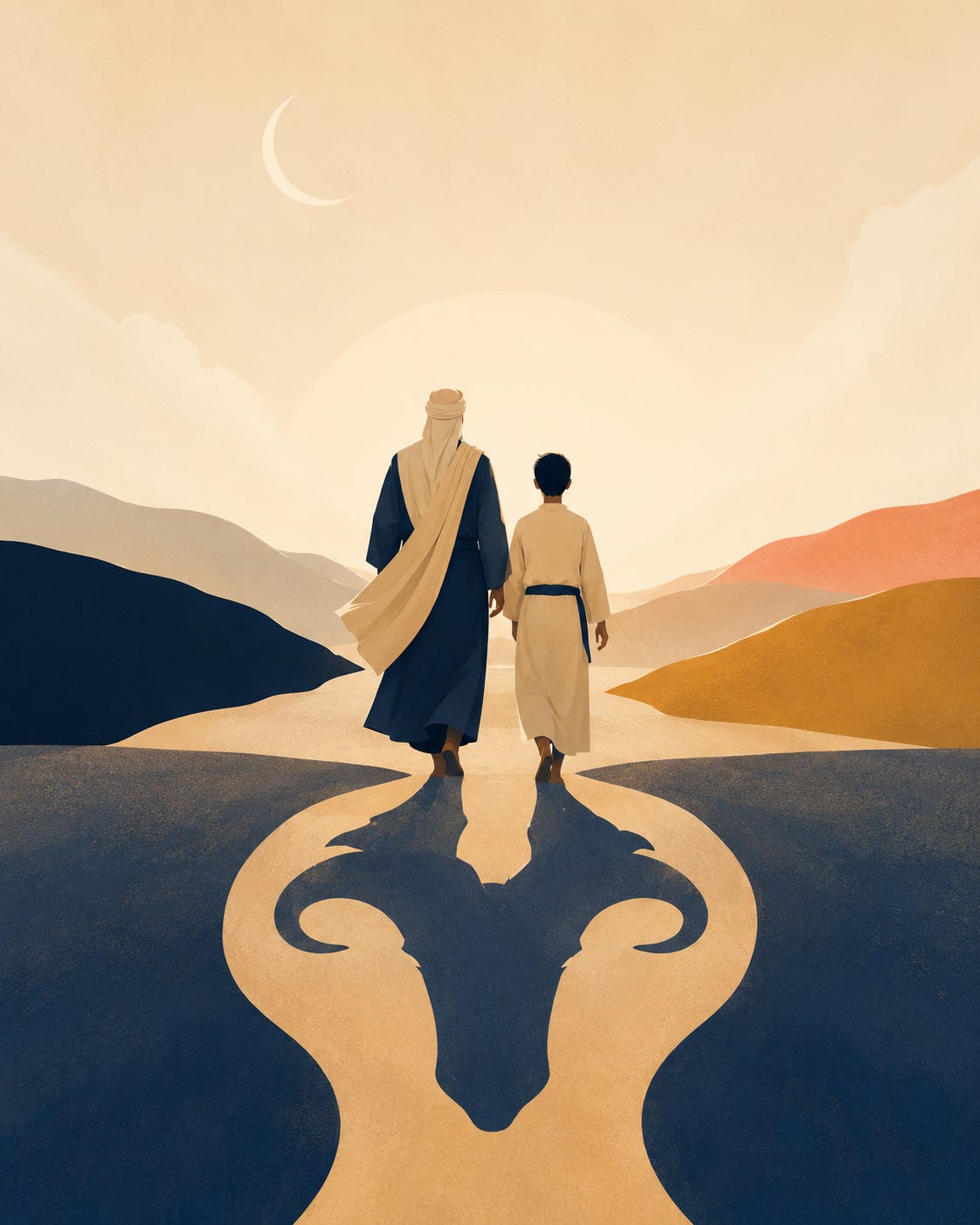
None of these things are wrong in themselves. But they reveal a gap—a wide one—between the ritual of Eid al-Adha and the meaning the ritual was intended to carry. When the Quran tells the story of Prophet Ibrahim’s willingness to sacrifice his son, it does not tell it as a historical anecdote. It tells it as a living curriculum, a set of moral and spiritual demands that each generation is supposed to internalize, not merely commemorate. The festival, along with its companion season of the first ten days of Dhul Hijjah, was built as an annual opportunity for that internalization.
This article is an attempt at a corrective. Drawing from the Quran, authenticated Prophetic traditions (hadith), and classical Islamic scholarship, it examines what the sources actually say—about the story, the sacrifice, the ten days, and the obligations—and where popular understanding has drifted from the textual record. The aim is not to scold but to restore: to return to the source material what cultural repetition has gradually worn away.
What the Quranic Text Actually Says
The primary Quranic account of Ibrahim’s sacrifice appears in Surah As-Saffat (37:99–113). Most Muslims know the storyline: Ibrahim is commanded to sacrifice his son, he prepares to obey, and Allah intervenes with a ram at the last moment. But a careful reading of the Arabic reveals details that popular retellings consistently omit—details that fundamentally shape the meaning of the story.
First, the dream was not a single event. When Ibrahim tells his son about the divine command, the Quran uses the phrase innī arā fil manāmi (37:102)—“I see [keep seeing] in the dream.” The verb arā is in the present tense (mudhari‘), not the past. Classical commentators including Ibn Kathir note that this indicates Ibrahim experienced the vision repeatedly, not once. This was sustained spiritual testing over time—not a single dramatic night.
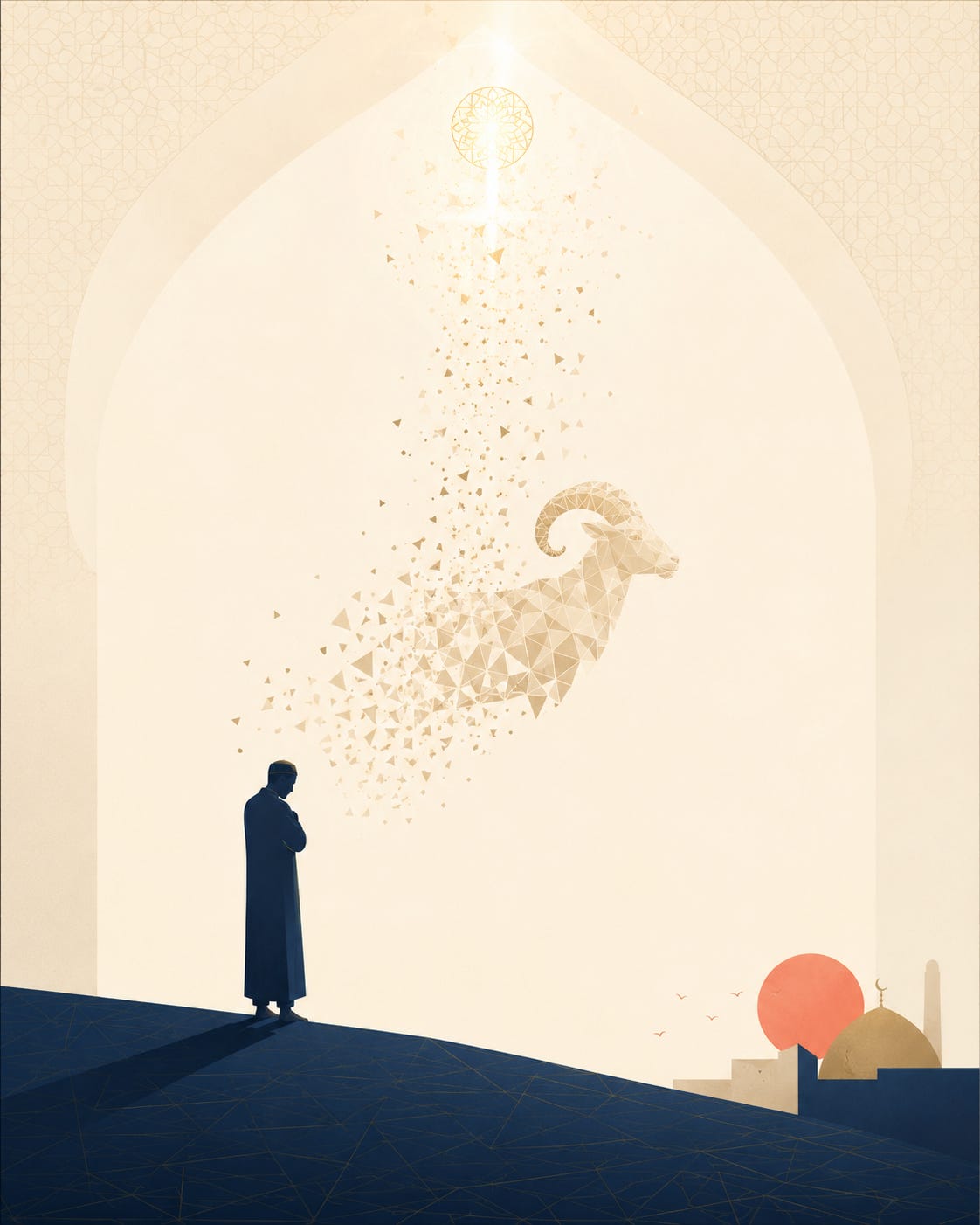
Second, Ibrahim consulted his son. He said: fa-ndhur mādhā tarā—“So tell me what you think” (37:102). This is not a father seeking permission to override a divine command (received via dream). Rather, as one interpret of Quran explains, Ibrahim was testing whether his son was a true son in faith, not merely in biology. Ibrahim was not informing a victim — he was inviting a partner. By telling his son openly, he gave Ismaeel the dignity of choosing to walk toward the test with his eyes open, transforming him from the object of sacrifice into a conscious participant in surrender.
Ismaeel’s response is recorded without embellishment:
قَالَ يَا أَبَتِ افْعَلْ مَا تُؤْمَرُ سَتَجِدُنِي إِن شَاءَ اللَّهُ مِنَ الصَّابِرِينَ
“O my dear father! Do as you are commanded. You will find me, if Allah wills, among the steadfast.” (Surah As-Saffat 37:102 — quran.com/as-saffat/102)
How many questions did Ismaeel ask? Zero. How many conditions did he attach? None. He added only one qualifier: in shā’a Allāh—acknowledging that even his patience was not self-generated but dependent on divine support. This is a level of theological precision from a young man that most adults never reach.
Third, the Quran credits both father and son equally. The pivotal verse reads: fa lammā aslamā—“when they both submitted” (37:103). The dual verb form in Arabic makes clear that this was a joint act of faith. Ibrahim’s willingness alone was not enough to fulfill the test; Ismaeel’s willing participation was essential. The sacrifice was a partnership in surrender.
Fourth, Ibrahim laid Ismaeel face-down, not face-up. The Quran says wa tallahu lil-jabīn—“he laid him on his forehead” (37:103). Scholars including al-Tabari explain that Ibrahim turned his son face-down deliberately, so he would not have to see his child’s face and risk hesitation. This small detail reveals something profound about the nature of obedience: Ibrahim did not trust his own emotional strength. He engineered the conditions to ensure his submission would hold. He built scaffolding around his faith.
Fifth—and this is theologically critical—Allah did not say “you have completed the sacrifice.” He said: qad saddaqta al-ru’yā—“You have proven the dream true” (37:105). The knife never reached Ismaeel. A ram was sent as ransom (37:107). The entire Quranic presentation of this narrative points to a single conclusion: the test was about willingness, not completion. The sacrifice that matters to Allah is the interior one.
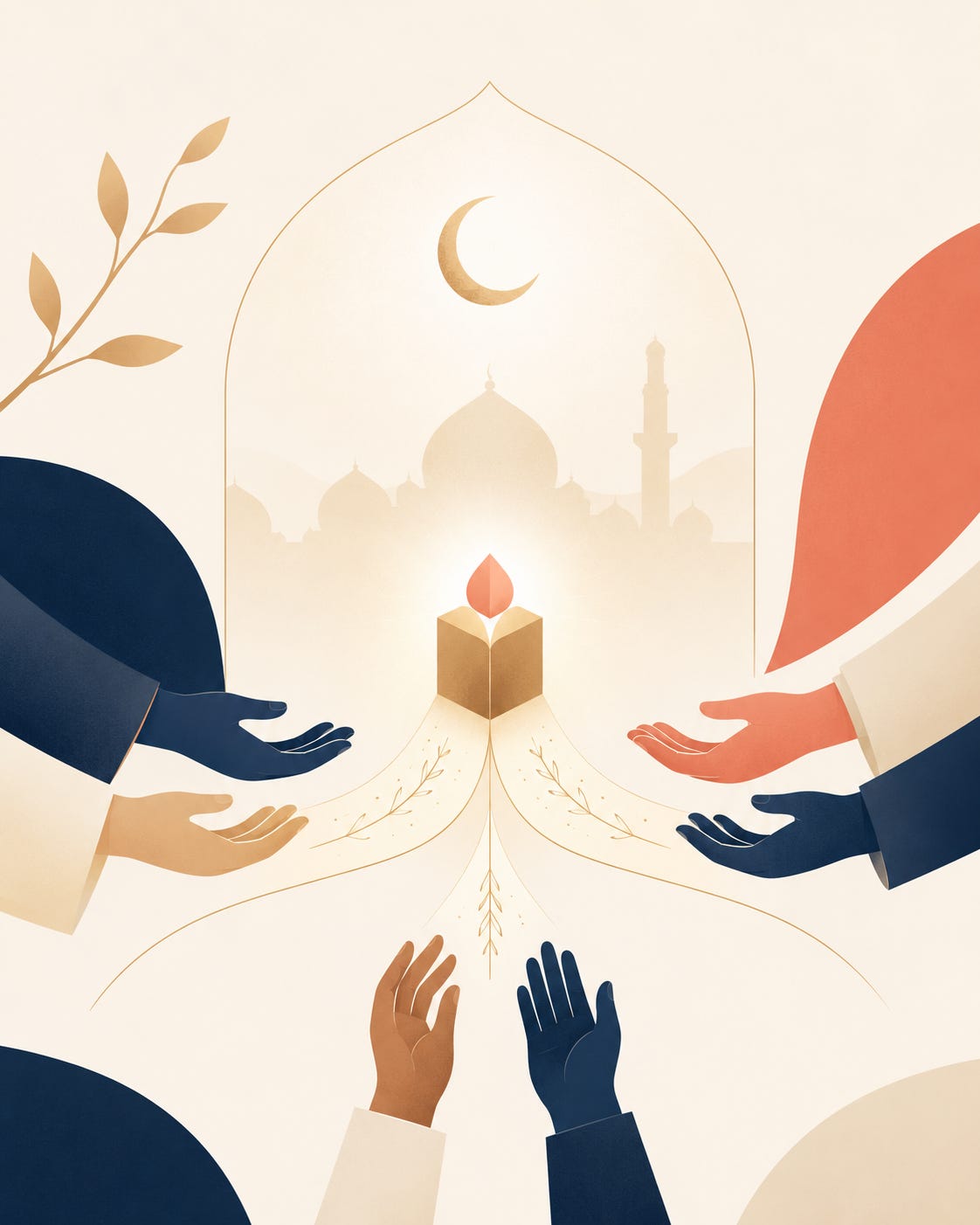
This is confirmed explicitly in a verse that every Muslim who offers qurbani should know by heart:
لَن يَنَالَ اللَّهَ لُحُومُهَا وَلَا دِمَاؤُهَا وَلَـكِن يَنَالُهُ التَّقْوَىـ مِنكُمْ
“It is not their meat nor their blood that reaches Allah; rather, it is your taqwa (God-consciousness) that reaches Him.” (Surah Al-Hajj 22:37)
Details the Popular Story Leaves Out
Beyond the core narrative, several authenticated details from hadith literature and classical tafsir are routinely absent from popular retellings. These are not peripheral footnotes—they are connected to living Islamic practices:
Shaytan’s three interventions. Traditions narrated in Musnad Ahmad describe Shaytan appearing three times to dissuade the family—approaching Ibrahim, Hajar, and Ismaeel in turn. At each encounter, Ibrahim pelted him with seven stones. This became the origin of the Rami al-Jamarat (the stoning of the pillars), a mandatory rite of Hajj that pilgrims perform to this day. The ritual is not abstract symbolism; it is a direct reenactment of Ibrahim’s rejection of temptation.
The ram’s horns survived for centuries. Ibn Abbas and Ash-Sha’bi both reported seeing the horns of the sacrificial ram hanging inside the Ka’bah, where they were preserved as a physical relic until the siege of Abdullah ibn al-Zubayr’s era. Ibn Kathir documents this in his Tafsir on verse 37:107. The preservation suggests early Muslims understood the sacrifice not as mythology but as historical event with tangible continuity.
Hajar’s act became eternal worship. Before the sacrifice narrative, Ibrahim was commanded to leave his wife Hajar and infant Ismaeel in the barren, uninhabited valley of Makkah (Surah Ibrahim 14:37). Hajar’s desperate search for water—running seven times between the hills of Safa and Marwa—is detailed in Sahih al-Bukhari (3364). The well of Zamzam sprang forth beneath Ismaeel’s feet. That desperate maternal act became Sa’i, a mandatory rite of both Hajj and Umrah. This is arguably one of the most powerful statements in all of Islamic tradition about the spiritual agency of women: a mother’s survival instinct, sanctified by Allah, became an obligation for every pilgrim—male and female—until the end of time.
The son was Ismaeel, not Ishaq. A persistent confusion, partly inherited from Biblical tradition, identifies the sacrificial son as Ishaq (Isaac). The Quran’s own structure resolves this. The sacrifice narrative occupies verses 37:100–107. The glad tidings of Ishaq appear separately, after the sacrifice story, as an additional blessing (37:112). The sacrifice took place in Makkah, not in Syria where Ishaq lived. The physical evidence of the ram’s horns inside the Ka’bah further confirms the Makkan setting. The majority of Islamic scholars, including Ibn Kathir, affirm that the son was Ismaeel.
Five Misconceptions That Need Correcting
1. “Qurbani Is Fard on Every Muslim”
This is more nuanced than commonly understood. There is a legitimate scholarly difference on this question. The Hanafi school—dominant in South Asia, including Bangladesh—classifies qurbani as wajib (obligatory) for every sane, adult, non-traveling Muslim who possesses wealth at or above the nisab threshold. The evidence cited is a hadith with strong wording: “Whoever can afford to offer a sacrifice but does not do so, let him not come near our place of prayer” (Ibn Majah 3123). The Shafi’i, Maliki, and Hanbali schools, however, classify it as Sunnah Mu’akkadah—a strongly emphasized practice that is not technically obligatory. Their evidence includes reports that Abu Bakr and Umar (may Allah be pleased with them) refrained from offering sacrifice in certain years specifically to demonstrate that it was not compulsory (al-Bayhaqi). The practical consensus across all schools: if you have the means, there is no scholarly justification for skipping it.
2. “The Sacrifice Is About the Meat”
As Al-Hajj 22:37 states unambiguously, neither the flesh nor the blood reaches Allah. What reaches Him is taqwa—the God-consciousness and sincerity behind the act. The physical sacrifice is a symbol of a deeper, interior sacrifice: the willingness to surrender what one values most for Allah’s sake. Without this interior dimension, the act of slaughter is reduced to a protein transaction. The question the festival poses to each believer is not “how large is your animal?” but “what is your Ismaeel?”—what attachment, habit, comfort, or disobedience are you willing to give up?
3. “The First 10 Days of Dhul Hijjah Are Just the Lead-Up to Eid”
This may be the most consequential misconception on this list. The Prophet Muhammad (ﷺ) said:
مَا مِنْ أَيَّامٍ الْعَمَلُ الصَّالِحُ فِيهَا أَحَبُّ إِلَى اللَّهِ مِنْ هَذِهِ الأَيَّامِ
“There are no days during which righteous deeds are more beloved to Allah than these days” — meaning the first ten days of Dhul Hijjah. (Sahih al-Bukhari 969 — sunnah.com/bukhari:969)
The Companions asked: “Not even jihad in the cause of Allah?” He replied: “Not even jihad, except for a man who goes out with his life and wealth and returns with nothing.” The implications are staggering. These ten days rank above Ramadan’s days in virtue. If the last ten nights of Ramadan are the most blessed nights of the year, the first ten days of Dhul Hijjah are the most blessed days. Yet most Muslims pass them without any heightened worship, unaware that a single act of charity, a single prayer, or even dhikr during these days carries more weight with Allah than the same deed at any other time.
The fasting of the Day of Arafah—the 9th of Dhul Hijjah—deserves particular emphasis. The Prophet (ﷺ) said:
صِيَامُ يَوْمِ عَرَفَةَ أَحْتَسِبُ عَلَى اللَّهِ أَنْ يُكَفِّرَ السَّنَةَ الَّتِي قَبْلَهُ وَالسَّنَةَ الَّتِي بَعْدَهُ
“Fasting on the Day of Arafah, I hope from Allah, expiates the sins of the year before it and the year after it.” (Sahih Muslim 1162 — sunnah.com/muslim:1162b)
Imam An-Nawawi clarified that this expiation applies to minor sins; major sins require dedicated repentance (tawbah). This fast applies to those not performing Hajj.
4. “Eid al-Adha Is Essentially a Cultural Celebration”
It is not. Eid al-Adha is, at its core, an act of worship (ibadah). The Eid prayer is an obligation or strong sunnah depending on the school. The takbeer—recited from the 1st of Dhul Hijjah through the 13th, and specifically after every obligatory prayer from Fajr on the 9th to Asr on the 13th (a span covering 23 prayers)—is a Prophetic practice that most communities have abandoned. Ibn Umar and Abu Hurayrah used to walk through the marketplace reciting takbeer aloud, and people would join in (Sahih al-Bukhari, Book of the Two Eids). The qurbani itself follows specific religious regulations. Reducing all of this to a social occasion with festive clothing and elaborate meals strips the day of its theological spirit. The celebration is not the point; the celebration is the reward for the worship.
5. “Hajj Is for the Pilgrims; Non-Pilgrims Just Celebrate Eid”
Every significant Eid al-Adha practice spiritually mirrors a Hajj rite. The takbeer echoes the talbiyah of the pilgrims. The sacrifice reenacts Ibrahim’s ransom. Abstaining from cutting hair and nails—a sunnah established in Sahih Muslim (Hadith # 1977) for those intending to offer sacrifice—symbolically connects the person to the pilgrim in ihram. Fasting on Arafah aligns the non-pilgrim with the millions standing on the plain of Arafat in supplication. One does not need a visa or a plane ticket to participate in the spiritual architecture of Hajj. The entire structure of Eid al-Adha was designed to extend the blessings and disciplines of pilgrimage to every Muslim, everywhere.
Four Principles Ibrahim Left Behind
Ibrahim’s story is not merely commemorative. It offers a living ethical framework—four principles that the Quran and Sunnah consistently reinforce, and that the festival of Eid al-Adha is designed to re-teach every year.
Obedience (Ta’ah). Allah described Ibrahim as ummatan qānitan lillāh—“a whole community by himself, perfectly obedient to Allah” (An-Nahl 16:120). This was not selective compliance. It was comprehensive, unhesitating responsiveness to divine guidance. The modern test of this principle is not dramatic—it is mundane. It shows up when a professional is offered a promotion that conflicts with Jumu’ah prayer, when a business owner must choose between halal and haram revenue streams, when a clear Quranic directive is inconvenient. Obedience, in Ibrahim’s model, does not negotiate.
Submission (Islam). Obedience and submission are related but distinct. One can obey a traffic law without believing in it. Submission goes deeper: it means trusting the Creator’s wisdom even when human logic cannot follow. Ibrahim declared: “I have set my face with full devotion towards Him Who created the heavens and the earth” (Al-An’am 6:79). The pivotal moment of the sacrifice is described with the verb aslamā—from the same root as the word Islam itself. To be Muslim is, etymologically and theologically, to be one who submits.
Sacrifice (Qurbani). The question Eid al-Adha poses to every believer is deeply personal: What is your “Ismaeel”? What is the most precious thing in your life that competes with your devotion to Allah? For some, it is the pursuit of wealth. For others, it is status, ego, a toxic habit, or a relationship that pulls them away from their faith. The physical act of sacrifice is a symbol—a yearly reminder that the believer is expected to identify and cut away whatever stands between them and their Creator. As one watches the knife during the qurbani, the internal reflection should be: what attachment of mine am I symbolically surrendering today?
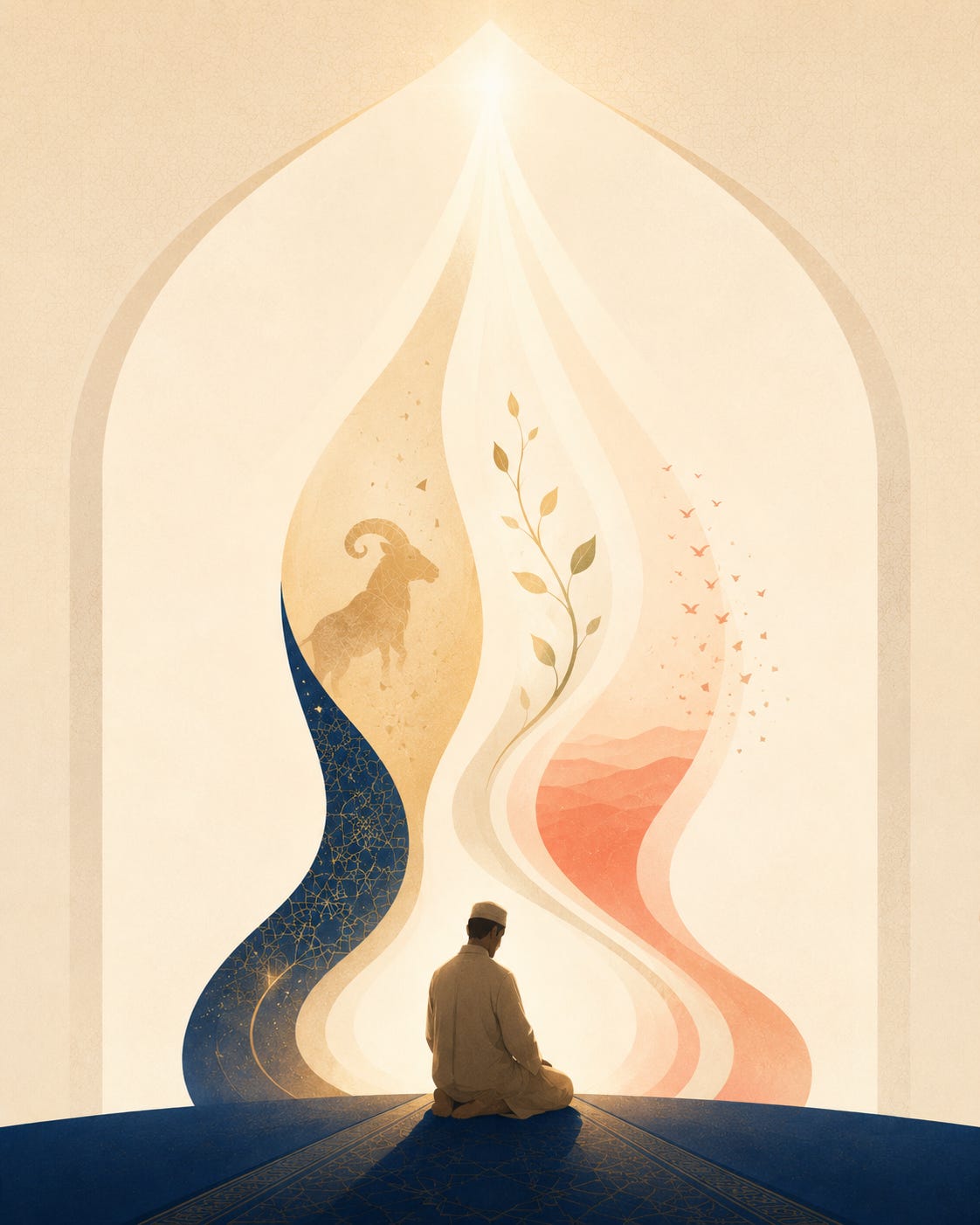
Sharing (Infaq). The traditional division of qurbani meat—one-third for the family, one-third for relatives and friends, one-third for the poor—is not an arbitrary custom. It is a structured training program in generosity. Eid al-Adha architecturally requires that every sacrifice results in redistribution. It insists that celebration and social responsibility are inseparable. In a global context where Muslim communities face crises in Palestine, Sudan, Myanmar, and elsewhere, this principle of compulsory sharing carries urgent practical weight.
What the Ten Days Demand
The following practices are established in authenticated sources. They are presented here not as a checklist but as a coherent spiritual program—an integrated response to the season’s call:
Fasting, particularly on the Day of Arafah (9th Dhul Hijjah), with its extraordinary reward of two years’ expiation of minor sins (Sahih Muslim 1162). The Prophet (ﷺ) was also reported to fast the first nine days of Dhul Hijjah.
Takbeer, both the general (unrestricted) takbeer throughout the first thirteen days and the restricted takbeer after every obligatory prayer from Fajr on the 9th to Asr on the 13th—twenty-three prayers in total. The wording: Allahu Akbar, Allahu Akbar, La ilaha illallah, Wallahu Akbar, Allahu Akbar, Wa lillahil Hamd. Umar ibn al-Khattab used to recite it in his tent in Mina so loudly that the entire area echoed. This is, by scholarly consensus, a forgotten sunnah in urgent need of revival.
Dhikr, du’a, and Quran recitation. The Prophet (ﷺ) instructed: “Increase in these days your Tahleel (La ilaha illallah), Takbeer (Allahu Akbar), and Tahmeed (Alhamdulillah)” (Musnad Ahmad 5446).
Sadaqah—amplified in reward during these days beyond any other period of the year.
Qurbani arrangement—with sincere intention, whether performed locally or through a trusted organization distributing to those in need.
Abstaining from cutting hair and nails for those intending to sacrifice, from the sighting of the Dhul Hijjah moon until the sacrifice is performed (Sahih Muslim 1977).
Sincere repentance (tawbah)—using the blessed days as a window for genuine spiritual reset.
Reconciliation—mending broken relationships before Eid arrives. The Prophet (ﷺ) warned that forgiveness is withheld from those who maintain unresolved enmity with a fellow Muslim (Sahih Muslim 2565).
The Question the Festival Asks
Eid al-Adha, properly understood, is not a holiday. It is a moral examination that returns every year. It asks each Muslim: Are you willing to obey when obedience is inconvenient? To submit when submission defies your ego? To sacrifice when sacrifice costs you something real? And to share when hoarding is easier?
The distance between understanding these questions intellectually and answering them with one’s life is precisely the distance the festival was designed to close. Ibrahim did not merely believe in God—he was described as a “whole community by himself” because he lived his belief to its ultimate consequence. The Quran does not ask us to match his specific test. It asks us to match his disposition: the readiness to hear and obey, the trust to submit beyond logic, the courage to sacrifice what we love most, and the generosity to share what remains.
The Quran captures the entirety of this examination in a single verse:
قُلْ إِنَّ صَلَاتِي وَنُسُكِي وَمَحْيَايَ وَمَمَاتِي لِلَّهِ رَبِّ الْعَالَمِينَ
“Say: My prayer, my sacrifice, my life, and my death are all for Allah, the Lord of all the worlds.” (Surah Al-An’am 6:162 — quran.com/al-anam/162)
The biryani and new clothes are fine. Enjoy them. But do not mistake the celebration for the substance. The substance is in whether your prayer, your sacrifice, your life, and your death are genuinely oriented toward the One who created you. That is what Ibrahim demonstrated. That is what the festival commemorates. And that is the question it asks you again this year.
Taqabbalallahu minna wa minkum. May Allah accept from us and from you.
Sources
Quran: Surah As-Saffat 37:99–113 (quran.com/as-saffat/99–113); Surah An-Nahl 16:120 (quran.com/an-nahl/120); Surah Al-Hajj 22:37 (quran.com/al-hajj/37); Surah Al-An’am 6:79 & 6:162 (quran.com/al-anam/79, quran.com/al-anam/162); Surah Ibrahim 14:37 (quran.com/ibrahim/37); Surah Al-Baqarah 2:127 (quran.com/al-baqarah/127).
Hadith: Sahih al-Bukhari 969 (sunnah.com/bukhari:969); Sahih al-Bukhari 3364 (sunnah.com/bukhari:3364); Sahih al-Bukhari 7280 (sunnah.com/bukhari:7280); Sahih Muslim 1162 (sunnah.com/muslim:1162b); Sahih Muslim 1977 (sunnah.com/riyadussalihin:1706); Sahih Muslim 2565 (sunnah.com/muslim:2565); Musnad Ahmad 5446; Sunan Ibn Majah 3123.
Tafsir & Scholarship: Ibn Kathir, Tafsir al-Quran al-Azim (on 37:102–107); al-Tabari, Jami’ al-Bayan (on 37:103); Maududi, Tafheem ul-Quran (on 37:102); Imam An-Nawawi, Sharh Sahih Muslim (on 1162); al-Bayhaqi, al-Sunan al-Kubra (on the practice of Abu Bakr and Umar regarding sacrifice).