

Muslim Demography, Fear, and Erasure: Revisiting Richard Eaton's Bengal Frontier
Why Bengal became home to one of the world's largest Muslim populations is an old question. Today, it is being answered by bulldozers, border fences, and voter roll deletions in the West Bengal.

বাংলার বদ্বীপ কীভাবে পৃথিবীর অন্যতম বৃহত্তম মুসলিম জনগোষ্ঠীর আবাসভূমি হয়ে উঠল—এ প্রশ্ন নতুন নয়। শতাব্দীর পর শতাব্দী ধরে তা ইতিহাসবিদ, ঔপনিবেশিক প্রশাসক ও জনসংখ্যাবিদদের ভাবিয়ে এসেছে। কিন্তু আজ এর উত্তর দেয়া হচ্ছে জ্ঞান-গবেষণায় নয়, বরং বুলডোজার, সীমান্ত-বেড়া আর ভোটার তালিকা থেকে নাম মুছে ফেলার মধ্য দিয়ে।
When the American historian Richard Maxwell Eaton published his landmark study The Rise of Islam and the Bengal Frontier, 1204–1760, in 1993, he was asking a question that had long vexed scholars: how did the Bengal delta — a vast, swampy, forested frontier — become the home of the world’s second-largest Muslim ethnic population? Drawing on archaeological evidence, Mughal administrative documents, poetry, and narrative histories, Eaton argued that the answer lay not in conquest or coercion, but in the gradual eastward movement of agrarian settlement and Sufi Islam during the sixteenth and seventeenth centuries. The fertile lands surrounding the Padma River, he showed, were Islamicized not through the sword but through the plough.
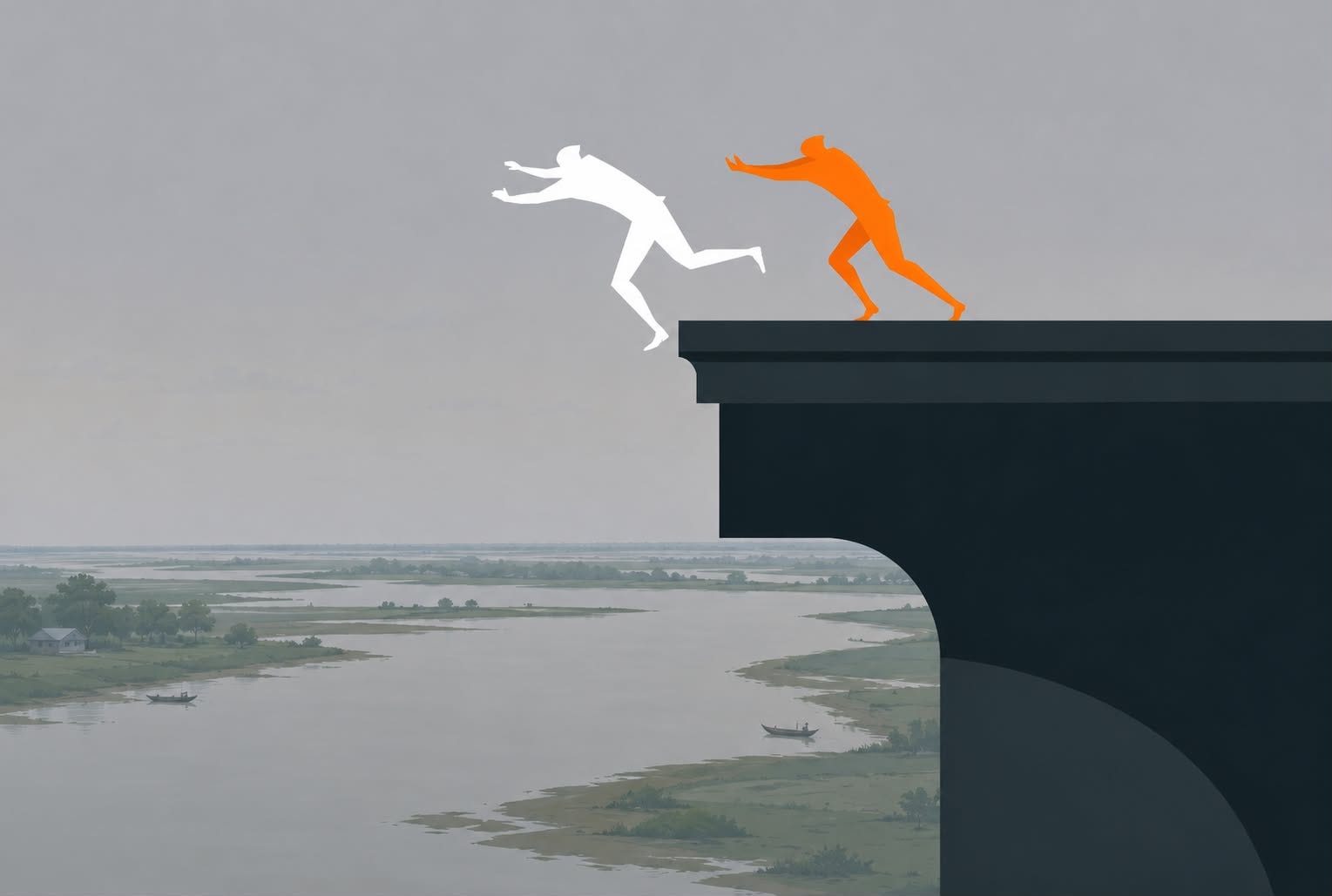
Eaton’s scholarship offered a corrective to older, more ideologically charged explanations. Yet the question he posed has never truly left the political arena. Today, eight centuries after the first Muslim sultanates took root in Bengal, the demographic presence of Muslims in West Bengal and Assam is once again at the center of a profound and dangerous political project — one that threatens to rewrite history not in libraries, but in the lives of millions of ordinary people.
A Census, a Shock, and the Birth of Communal Arithmetic
The modern politics of Muslim demography in Bengal begins, like so much else in South Asian history, with the British. When the colonial administration conducted its first census of Bengal province in 1872, officials were astonished by what they found. Muslims constituted more than 70 percent of the population in districts such as Chittagong, Noakhali, Pabna, and Rajshahi, and over 80 percent in Bogra. Here, in the swamplands and river deltas of eastern Bengal, was a Muslim peasant majority that the colonial imagination had not anticipated.
The historian W.W. Hunter attempted to explain this away through the theory of mass conversion from the lowest strata of Hindu society. This framework — which divided Bengali Muslims into the supposedly ‘respectable’ ashraf (of north Indian or Arab descent) and the lower-class atrap (converted from low-caste Hindus) — was as much a political intervention as an academic one. It framed Muslim identity in Bengal as derivative, recent, and suspect. The ashraf lived in Calcutta and urban centers; the atrap were poor peasants in the countryside. They were, in the colonial imagination, different peoples inhabiting different worlds.
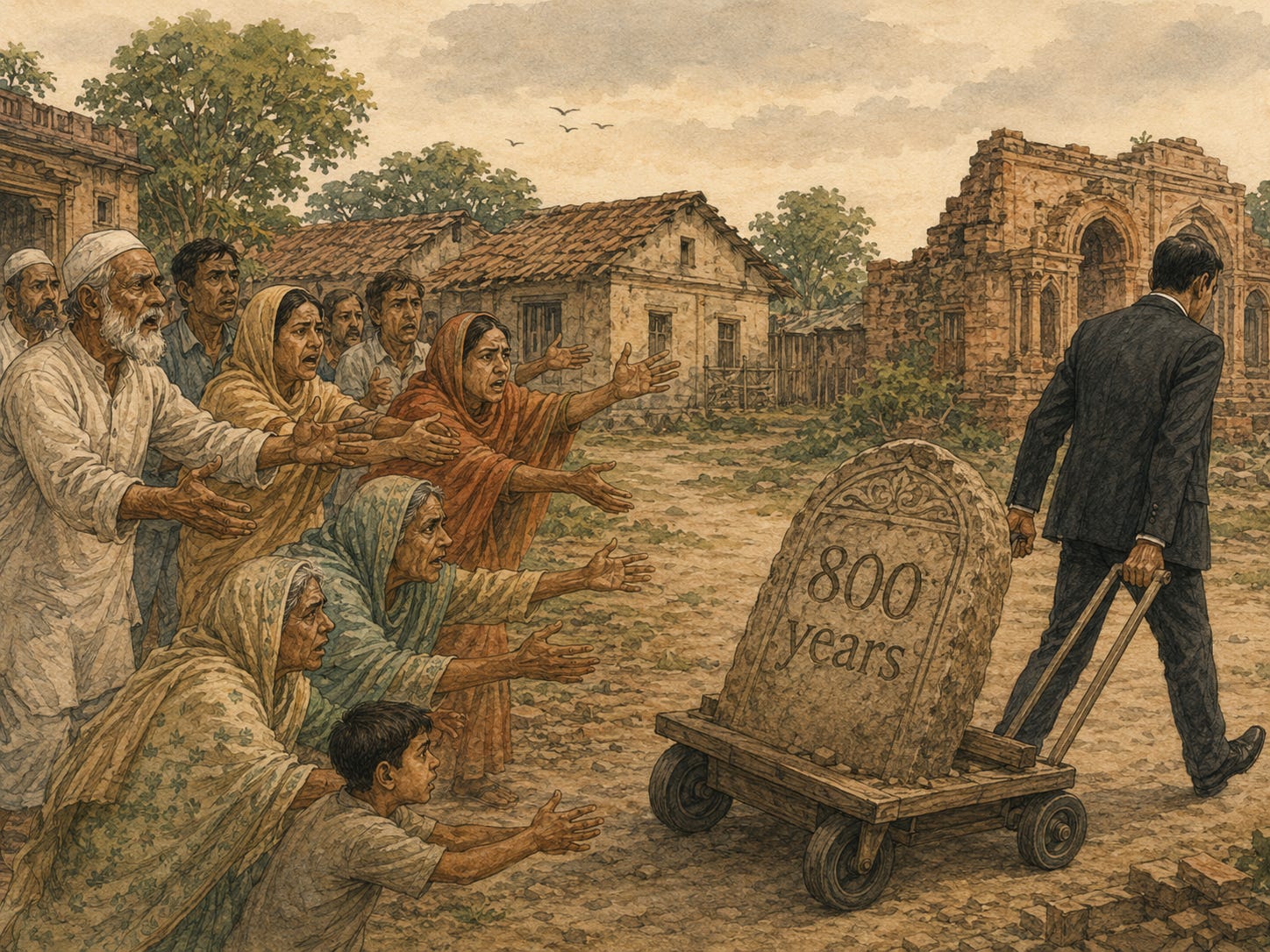
It was against this backdrop that Bengali cultural nationalism emerged — and it emerged, critically, as a Hindu project. Bankim Chandra Chatterjee’s Anandamath, published in 1882, gave literary form to what would later be recognized as Hindu nationalist politics. The Bengali Renaissance, centered on Calcutta and the aspirations of the Bhadrolok (educated upper-caste Hindu gentry), constructed an identity that was culturally Hindu in its orientation and geographically ambiguous about the Muslim majority east. The first Partition of Bengal in 1905 — which the British justified partly on religious demography — hardened these identities into territorial and political categories. The binary of Hindu west and Muslim east had been drawn.
Partition, Displacement, and the Long Shadow of 1947
The Partition of India in 1947 was supposed to resolve the question of Bengal’s mixed demography through the surgical separation of populations. It did not. West Bengal emerged with a large Muslim minority population, while the rural Bengali-speaking Muslims on one side of the border (West Bengal) and the Namasudra Hindu community on the other (Bangladesh) both became pawns in post-colonial nation-building processes. Partition did not end communal politics in Bengal; it simply gave it new borders.
In West Bengal after Partition, the Muslim population fell sharply — from 29.48 percent in 1941 to 19.46 percent in 1951 — as millions fled or were displaced. But from 1951 onwards, the Muslim population grew steadily through natural increase, as the table below illustrates.
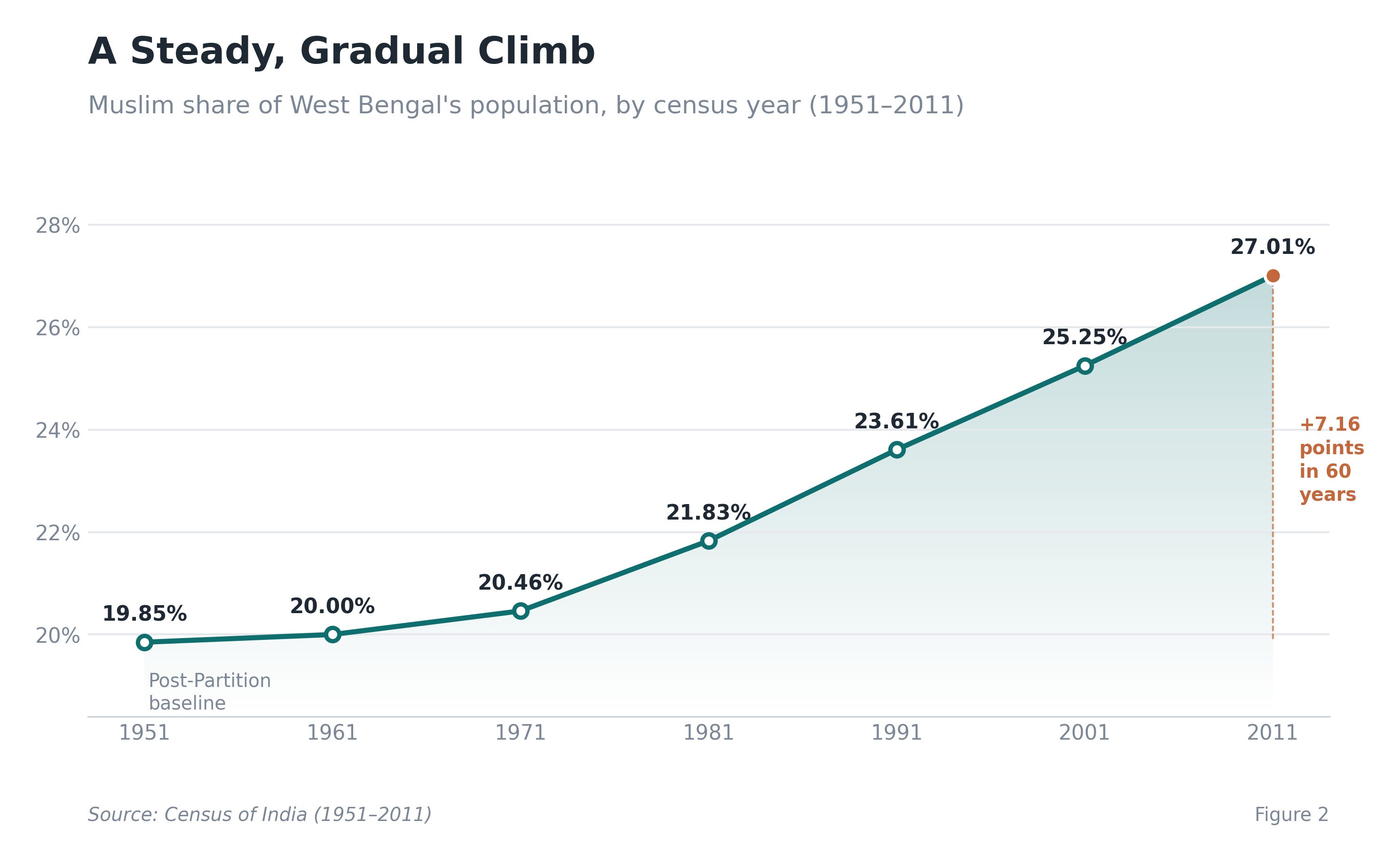
This growth is real, but it is biological — the product of higher fertility rates among a younger, poorer, and more rural demographic group. The Total Fertility Rate (TFR) among Muslims in West Bengal has indeed been higher than among Hindus, but the gap has closed dramatically over three decades: from a Muslim TFR of 4.0 against a Hindu TFR of 2.6 in 1992–93 (NFHS-1), to 2.1 against 1.6 in 2019–21 (NFHS-5). The Muslim TFR declined by 55.8 percent over this period, compared to 41.7 percent for Hindus — a convergence that demographers attribute primarily to improvements in women’s education and socioeconomic conditions, not to any cultural or religious imperative.
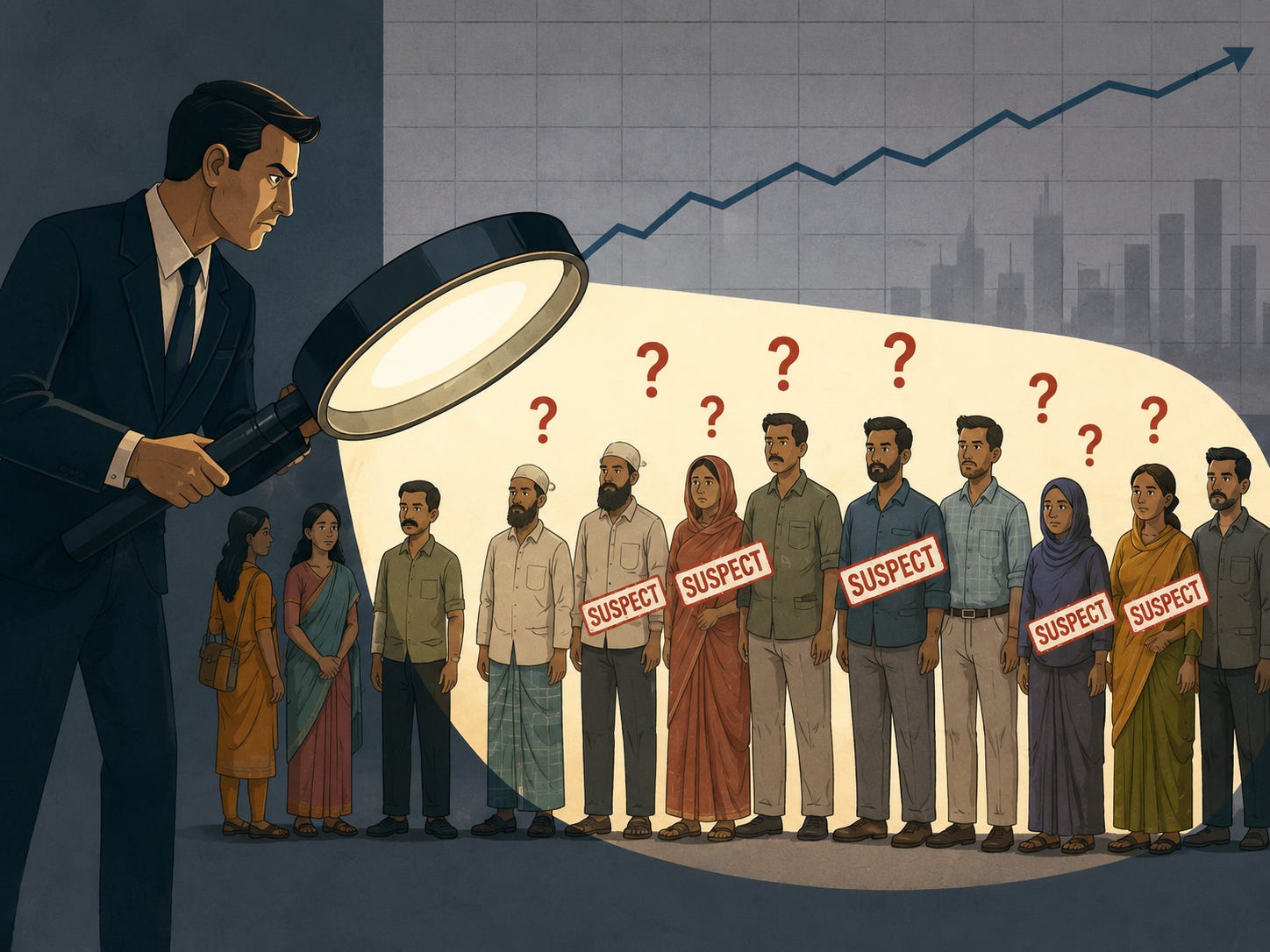
The data are unambiguous: if large-scale illegal immigration from Bangladesh were occurring at the scale alleged by India’s ruling Bharatiya Janata Party (BJP), West Bengal’s Muslim population would show anomalous growth. It does not. Since 1981, West Bengal’s overall population growth rate has consistently been lower than India’s national rate. Between 2001 and 2011, the growth rate of the Hindu population in West Bengal’s border districts fell by 6.75 percentage points; that of Muslims fell by 4.27 percentage points. Both communities are declining in growth. The infiltration narrative is contradicted by the government’s own demographic data.
Figure 1: Total Fertility Rate Trends by Religious Community (National Family Health Survey (NFHS-1 to NFHS-5), Government of India)
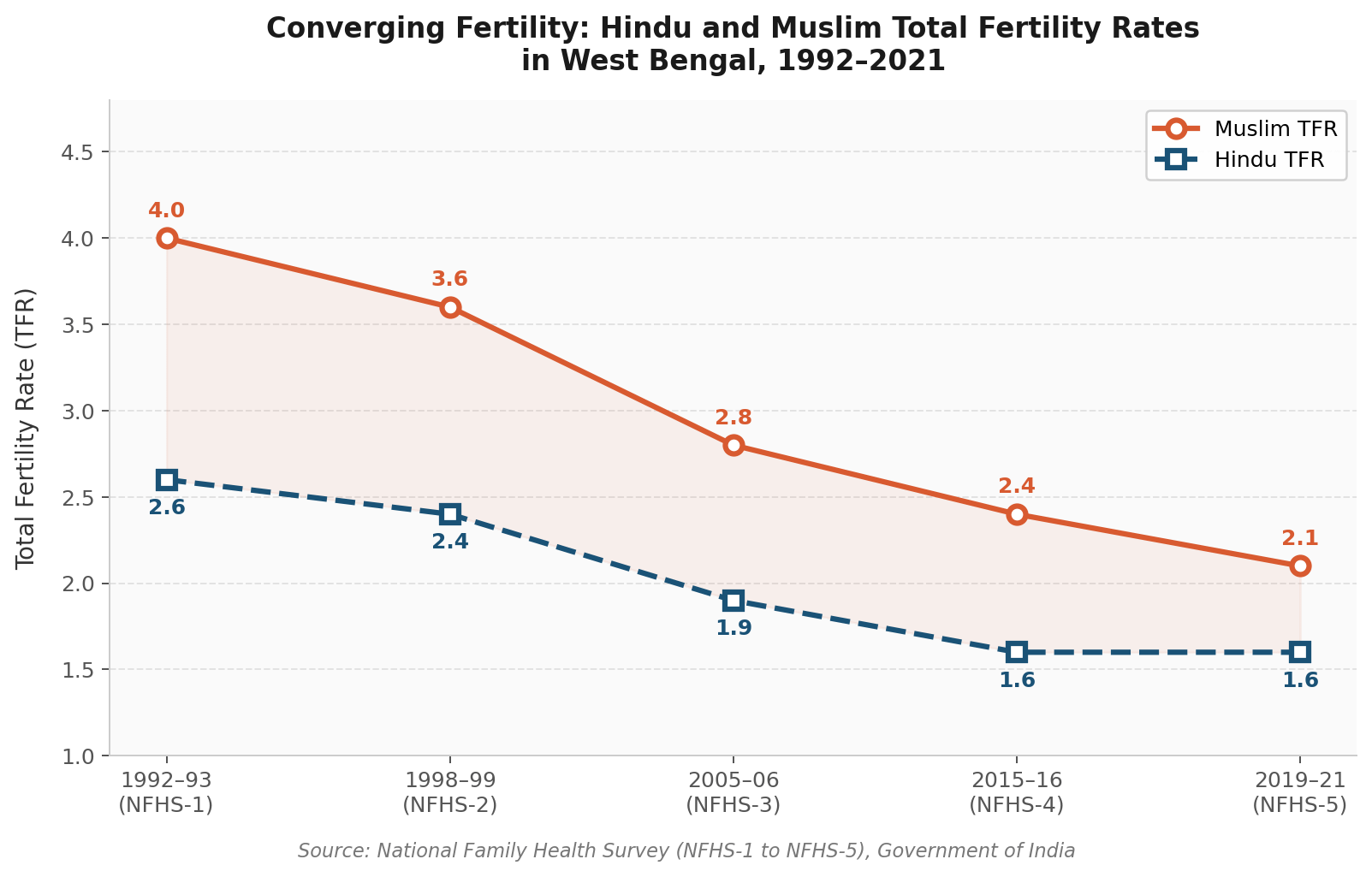
Note: TFR = Total Fertility Rate (average number of children born per woman). The gap between Muslim and Hindu TFR has narrowed from 1.4 in 1992–93 to 0.5 in 2019–21, driven primarily by improvements in women’s education and socioeconomic conditions rather than religious factors alone.
From the Sachar Committee to Manufactured Fear
For much of the post-Partition period, the Muslim population of West Bengal was a demographic fact rather than a political flashpoint. That changed in 2006, when the Sachar Committee Report — commissioned by the Congress-led government — documented that Indian Muslims, and Bengali Muslims in particular, ranked among the most socioeconomically marginalized communities in the country, faring worse than Scheduled Castes and Scheduled Tribes on most indicators of education, employment, and income. The report was a watershed. It brought Muslim political visibility to the fore and opened the question of who could win the Muslim vote in the name of development.
The Trinamool Congress (TMC) came to power in West Bengal in 2011 partly on the strength of Muslim electoral support, with promises of empowerment and inclusion. Yet this very fact became a source of sustained attack. Critics — led increasingly by the BJP — accused Chief Minister Mamata Banerjee of “Muslim appeasement,” deploying the language of illegitimacy around any policy that sought to redress the marginalization the Sachar Committee had documented. The demographic growth of Muslims, legitimate and documented, was transformed in BJP rhetoric into evidence of infiltration. A statistical reality was recast as a security threat.
The Eastern Frontier and the Politics of Erasure
Since the BJP’s rise to national power in 2014 and following its historic victory in the West Bengal assembly elections of 2026, the politics of Muslim demography have taken a more aggressive and institutional form. The BJP used the Election Commission of India’s Special Intensive Revision (SIR) process to delete 91 lakh (9.1 million) names from West Bengal’s electoral rolls — the largest electoral revision in any Indian state in history. A further 6 million were deleted in Bihar, and hundreds of thousands flagged as ‘D-voters’ (doubtful voters) in Assam. In total, more than 15 million names were removed across three states, disproportionately affecting Muslim, Bengali-speaking, and marginalised communities.
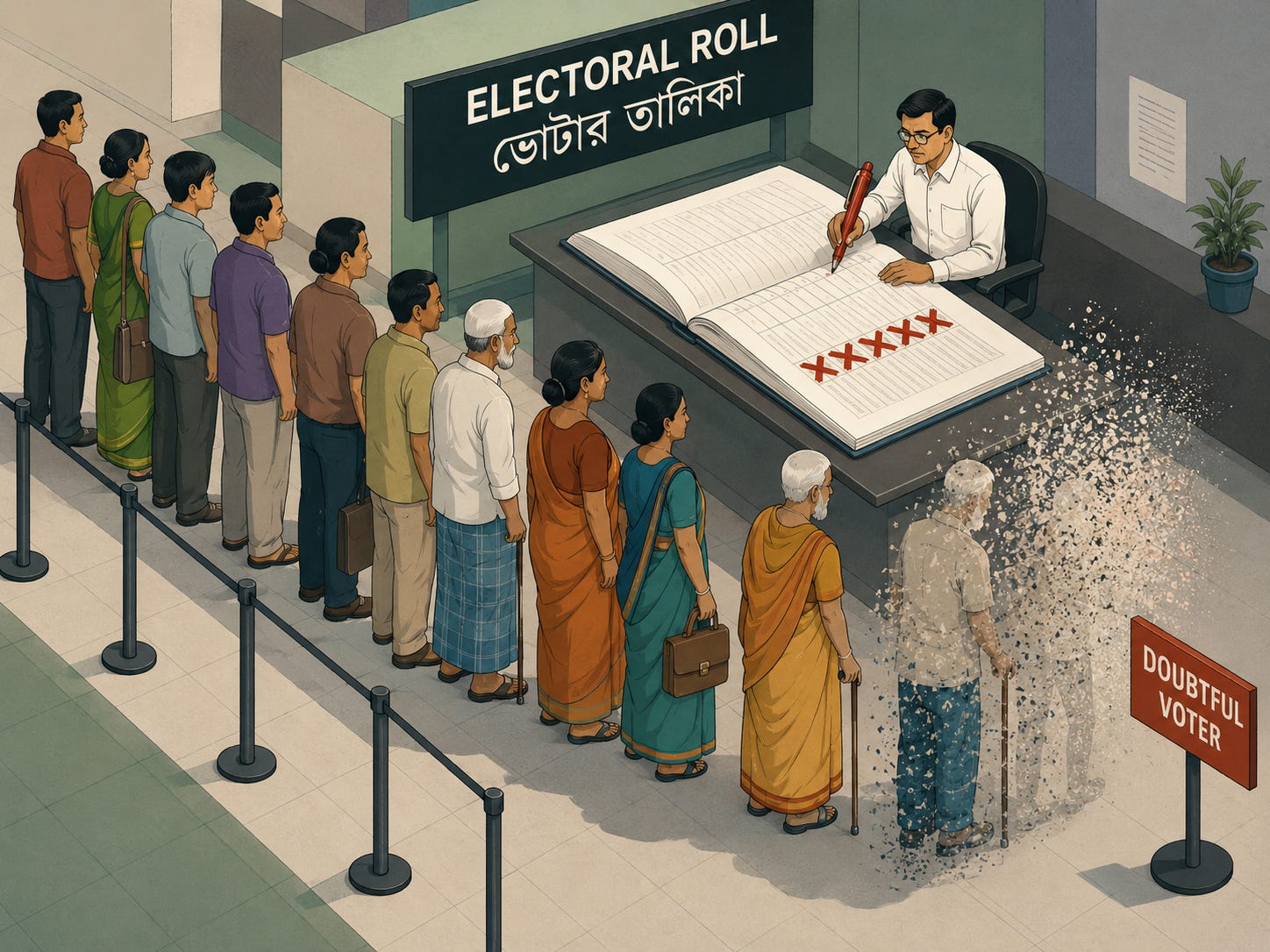
The slogan driving this project — “Detect, Delete, and Deport” — signals an intent that goes well beyond electoral administration. The BJP and the broader Hindutva movement have worked systematically to blur the distinction between a D-voter (an Indian citizen whose documentation is questioned) and an illegal Bangladeshi migrant. Through coordinated media narratives, social media campaigns, and political messaging, twenty million people are being constructed as ‘doubtful citizens’ — erased from voter rolls, stripped of welfare entitlements, and recast as foreign infiltrators.
The chief ministers of Assam and West Bengal, Himanta Biswa Sarma and Suvendu Adhikari, have placed the Bangladesh border at the center of their political identities, turning ‘push-backs’ and anti-immigration campaigns into theatre. Adhikari’s call to “teach Bangladesh a lesson like Israel did in Gaza” is not an aberration — it is the logical endpoint of a rhetoric that has been building for years. These developments are already straining diplomacy, trade, and India’s long-term strategic interests in the eastern region.
History Does Not Repeat Itself — But It Rhymes
Richard Eaton’s insight was that the Islamicization of Bengal was a frontier process: gradual, agricultural, and rooted in the movement of ordinary people into uncultivated deltaic land. Today, another frontier process is underway on the Indian side of West Bengal — but this one moves in reverse. Where Eaton traced the expansion of a civilization, we are now witnessing the attempted administrative contraction of a people: the slow erasure of a Muslim population that has been part of the Bengal delta for eight centuries, reframed as recent arrivals, illegal guests, and threats to the nation.
The growth of the Muslim population in West Bengal is biological and real, documented across five rounds of the National Family Health Survey and consistent with socioeconomic patterns of fertility decline. Yet this real and measurable growth has been weaponized as an indicator of threat, just as the British colonizers did during the nineteenth and twentieth centuries through their divide and rule policies. When the 1872 census revealed a Muslim peasant majority across large parts of eastern Bengal, colonial administrators responded not with understanding but with suspicion — using demographic anxiety to justify the first Partition of Bengal in 1905. In post-colonial India, the same divide and rule formula has been revived. The same threat of Muslim population growth is now deployed by Hindutva right-wing groups to divide West Bengal’s population and consolidate political power. But this time, it is formulating an entirely new Bengal frontier for Muslims in post-colonial India, not a geographical frontier, but an administrative and electoral one.
Therefore, the question Eaton asked was why are there so many Muslims in the Bengal delta? has already been answered by history, demography, and scholarship. Now the same question is being repeated for West Bengal in a different form, through post-colonial nation-state agendas. And the answer remains the same. The Muslims of West Bengal belong to that soil. They are there because they have always been there. Their ancestors cleared the forests of the historical delta, ploughed the riverbanks of the Bhairab and the Jalangi, and built the mosques that still stand in Gaur, Pandua, and Murshidabad. They built the revolution of handloom textiles, fine Muslin weaving, and traditional crafts that clothed Mughal courts and global markets alike. They are Bengali Muslims from West Bengal. They are Indian. And they are being erased.
Key References
Eaton, R.M. (1993). The Rise of Islam and the Bengal Frontier, 1204–1760. University of California Press.
Government of India (2006). Social, Economic and Educational Status of the Muslim Community of India: A Report (Sachar Committee Report). Prime Minister’s High Level Committee.
National Family Health Survey (NFHS-1 to NFHS-5), 1992–2021. International Institute for Population Sciences, Mumbai.
Census of India (1951–2011). Office of the Registrar General and Census Commissioner, India.
Hunter, W.W. (1871). The Indian Musalmans. Trübner & Co., London.
Chatterjee, B.C. (1882). Anandamath. Bangadarshan Press, Calcutta.
Haque, I. and Patel, P.P. (2022). ‘Fertility differentials among religious groups in West Bengal’. Population Studies, 76(2), pp. 201–218.
About the Author
Mehebub Sahana is a researcher at the University of Manchester, specialising in political ecology, caste, and climate justice in South Asia. The views expressed are the author’s own.
Disclaimer: The views expressed in this article are the authors' own and do not necessarily reflect The Insighta's editorial stance. However, any errors in the stated facts or figures may be corrected if supported by verifiable evidence. | A guest post by
|