

Does Negative Election Campaigning Really Work?
Negative campaigning grabs headlines but offers little benefit. When politics focuses on accusation, policies fade and public trust erodes. Parties must offer vision and solutions, not just attacks.

নেতিবাচক নির্বাচনী প্রচারণা প্রায়ই সংবাদের শিরোনাম হয়। তবে দীর্ঘমেয়াদে তা খুব একটা উপকার বয়ে আনেনা। অভিযোগের রাজনীতি প্রতিদ্বন্দ্বী দলগুলোর ভবিষ্যৎ পরিকল্পনা ও নীতির জায়গাকে সংকুচিত করে এবং জনআস্থাও ক্ষতিগ্রস্ত হয়। তার বিপরীতে দলগুলোর উচিৎ- পারস্পরিক আক্রমণের বাইরে গিয়ে দেখানো - তারা সত্যিই দেশ ও জনগণের জন্য কী করতে চায়।
As Bangladesh enters another election season, negative campaigning has once again taken center stage. Since the official launch of the 2026 national parliamentary election campaign, both the Bangladesh Nationalist Party (BNP) and Bangladesh Jamaat-e-Islami have leaned heavily on attacks, counterattacks, and moral indictments, often framed around two powerful and emotionally charged themes: the legacy of the 1971 Liberation War and allegations of corruption, chandabaji (extortion), and abuse of power.
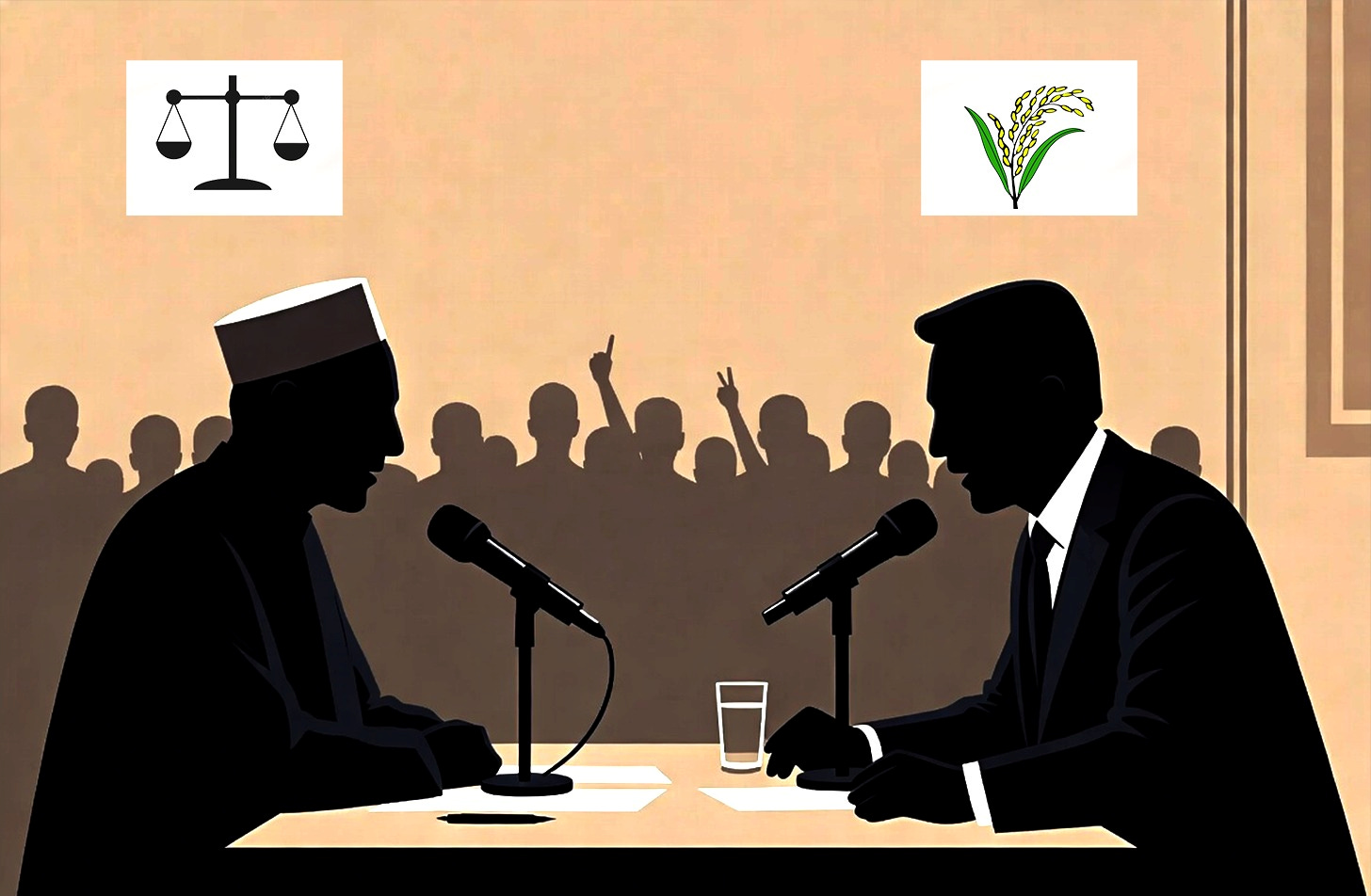
The central question is not whether negative campaigning dominates the discourse, it clearly does, but whether it works in the Bangladeshi political context. Does it persuade undecided voters, mobilize party loyalists, or instead deepen cynicism and disengagement in an already polarized political environment?
Anti-Liberation War vs. “Chandabaj”
From the outset of the campaign, BNP leaders have repeatedly invoked the role of Jamaat-e-Islami during the 1971 Liberation War, a long-standing fault line in Bangladeshi politics. At an election rally in Sylhet on January 22, BNP Chairperson Tarique Rahman reminded the audience of what he described as Jamaat’s historical position during the war.
Mr. Rahman said, “During the 1971 war, we saw the role many people played while the motherland was being liberated.” He followed this with a more pointed remark: “People saw you (Jamaat-e-Islami) back in ’71, brother; history cannot be erased. In ’71, people saw how you took a stand against the country.”
This line of attack is not new. The Liberation War has long functioned as a moral benchmark in Bangladeshi politics, conferring legitimacy on some actors while permanently discrediting others. By resurrecting this narrative, BNP appears to be attempting to delegitimize Jamaat’s political claims and remind voters of unresolved historical grievances.
Jamaat-e-Islami, however, has responded with a counter-narrative on social media and at election rallies, calling BNP activists “chandabaj.” Jamaat leaders and activists have repeatedly alleged corruption, extortion, and misrule during periods when the BNP was in power.
Women’s Leadership vs. Family Card
Another flashpoint emerged around Jamaat-e-Islami Ameer Dr. Shafiqur Rahman’s comments on women’s leadership. In an interview with Al Jazeera, he stated that no woman could become a leader of Jamaat-e-Islami, a remark that sparked strong criticism from BNP leaders, civil society members, and social media users.
In response, Dr. Shafiqur Rahman attempted to reframe the debate during a public rally in Chattogram. He argued that women do not want “a hand raised against them in one hand and a family card in the other.” Hinting at the BNP, he said, “A family card in one hand and a hand raised against our mothers in the other, no family card has any value compared to my mother’s dignity.”
This rhetorical move reflects a broader pattern in negative campaigning: attacks are often repackaged as moral critiques, blending political rivalry with appeals to cultural values, dignity, and honor. While such framing may resonate emotionally with some voters, it also risks deepening divisions and diverting attention from substantive policy debates.
When Negative Campaigning Crosses the Line
Yet negative campaigning carries risks, particularly when attacks are perceived as excessive, offensive, or detached from voters’ everyday concerns. That risk became evident following controversial remarks made by Barguna District Jamaat-e-Islami Assistant Secretary Shamim Ahsan while campaigning in the Barguna-2 constituency. Speaking at an election rally in Kata Khali of Patharghata upazila in support of Jamaat candidate Sultan Ahmed, Ahsan made inflammatory comments about the Dhaka University Central Students’ Union (DUCSU). He claimed DUCSU as a “den of drugs and prostitution.”
Once these remarks spread on social media, they triggered widespread outrage and criticism across the country. BNP leaders were quick to condemn the comments, and public backlash forced Jamaat to distance itself from Ahsan. He was eventually relieved of all party responsibilities, and his party membership was suspended.
This episode illustrates a key danger of negative campaigning: when attacks are perceived as reckless or disrespectful, they can overshadow a party’s core message and damage its credibility.
What does Research Say About Negative Campaigning?
Political campaign research offers mixed results about the effectiveness of negative election campaigning. Political scientists Ansolabehere & Iyengar (1995) suggest that negative messages can influence voter preferences and turnout, particularly when attacks come directly from a candidate or party rather than anonymous third parties.
However, meta-analysis of multiple studies on negative campaigning paints a more cautious picture. Negative campaigning is often found to be no more effective than positive campaigning in securing electoral victories in different political systems. In many cases, its effects on vote choice are modest or negligible (Lau, Sigelman, Heldman, & Babbitt, 1999)
More importantly, research consistently highlights the risks associated with negative campaigning. Excessive negativity can erode public trust in elections, political institutions, and democratic processes. It can also exacerbate political polarization, reinforcing “us versus them” thinking rather than encouraging deliberation or compromise.
Does Bangladesh fit the conditions where negativity works?
The Bangladeshi context presents a unique mix of factors that complicate the effectiveness of negative election campaigning.
From one perspective, political identity in Bangladesh is deeply entrenched. Many voters possess strong partisan loyalties shaped by history, ideology, and family tradition. In such an environment, negative campaigning may serve less to persuade undecided voters and more to energize existing supporters. Attacks invoking 1971 Liberation War, extortion, corruption, or moral decay can function as mobilization tools rather than persuasion tools.
Additionally, a significant portion of the electorate, particularly Gen Z voters, has grown increasingly disillusioned with traditional political rhetoric. For these voters, repetitive blame games and historical accusations may feel disconnected from pressing concerns such as employment, inflation, governance, and personal security. In such cases, negative campaigning risks reinforcing apathy rather than political engagement.
American political scientists Richard Lau, Lee Sigelman and Ivy Rovner (2007) argue that negative campaigning is most effective when voters are unfamiliar with candidates, attacks are substantive and credible, and the source is seen as trustworthy. In Bangladesh, where major political parties are widely known and public trust in political actors is often low, those conditions are only partially present.
The broader cost to democratic discourse
Even when negative campaigning delivers short-term tactical gains, its long-term consequences deserve scrutiny. When election campaigns are dominated by attacks rather than policy debates, voters receive little information about how parties plan to address economic challenges, governance reforms, or social inequalities. As a result, voters often know more about opponents’ shortcomings than about actual policy proposals.
Moreover, the normalization of negativity can lower the tone of political discourse, making inflammatory language and personal attacks seem acceptable. Over time, this may weaken democratic norms and reduce citizens’ faith in elections as meaningful mechanisms of choice.
Recent controversies surrounding campaign rhetoric, including Liberation War accusations versus chandabaji, women’s leadership versus the family card, and remarks about DUCSU, demonstrate how quickly negative campaigning can spiral into public outrage, disciplinary actions, and reputational damage.
Does a negative campaign really work?
The answer, as both research and recent Bangladeshi experience suggest, is complicated. Negative election campaigning can work under certain conditions. It can mobilize loyal supporters, reinforce existing beliefs, and occasionally sway undecided voters. But it is far from a guaranteed path to electoral success.
In Bangladesh, negative campaigning appears to function more as a tool for political signaling and identity reinforcement than as a decisive mechanism for winning over new voters. Its effectiveness is constrained by deep-seated polarization, low trust in political institutions, and growing voter fatigue with confrontational politics.
Ultimately, while negative campaigning may dominate headlines, rallies, and social media discussions, its ability to deliver lasting political advantage remains uncertain. What is clearer, however, is its cost: a political environment is increasingly defined by accusation rather than articulation, by moral condemnation rather than policy vision.
As Bangladesh’s democracy continues to evolve, the challenge for political parties may not be how effectively they attack their opponents, but whether they can convince voters that they offer something more than yet another round of negative campaigning.
About the Author
Dr. Zahed Arman is an Assistant Professor in the Department of Communication, Media and Theatre at Mississippi State University. His research focuses on political campaigns and audience behavior. He can be reached out at za231@msstate.edu
Disclaimer: The views expressed in this article are the authors' own and do not necessarily reflect The Insighta's editorial stance. However, any errors in the stated facts or figures may be corrected if supported by verifiable evidence. | A guest post by
|